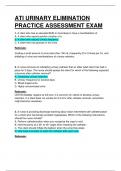
Ati Urinary Elimination Practice Assessment Exam. Questions And Answers With Rationales.
31. A nurse is teaching a client who has a new diagnosis of urge incontinence. Which of the following information should the nurse include in the teaching? (Select all that apply.) A. "Your provider might prescribe anticholinergic medications." B. "You should limit fluids in the evening." C. "You should restrict your intake of caffeine." D. "You might require intermittent urinary catheterization." E. "You might require an anterior vaginal repair." 32. A nurse is reviewing the medical record of a client who has a urinary tract infection (UTI). Which of the following findings should the nurse recognize as a risk factor? A. COPD B. Diabetes mellitus C. Anemia D. Osteoporosis 33. A nurse is caring for a client and observes that the client's urine is dark amber, cloudy, and has an unpleasant odor. The nurse should recognize that these findings are associated with which of the following? A. Urinary tract infection B. Urinary incontinence C. Urinary frequency D. Urinary retention 34. A nurse is caring for a client who is 5 hr postoperative following a transurethral resection of the prostate (TURP). The nurse notes that the client's indwelling urinary catheter has not drained in the past hour. Which of the following actions should the nurse take first? A. Notify the provider. B. Check the tubing for kinks. C. Adjust the rate of the bladder irrigant. D. Irrigate the catheter. 35. A nurse is caring for a female client who has recurrent kidney stones and is scheduled for an intravenous pyelogram. Which of the following statements by the client should the nurse report to the provider? A. "I drink at least 2 quarts of fluid every day." B. "The last time I voided it was painful and red-tinged." C. "My period ended 2 days ago." D. "I don't eat shellfish because it gives me hives." 36. A nurse in a long-term care facility is caring for an older adult client who has dementia and begins to have frequent episodes of urinary incontinence. After the provider determines no medical cause for the client's incontinence, which of the following interventions should the nurse initiate to manage this behavior? A. Remind the client to tell the nurse when he has to urinate. B. Use adult diapers to prevent frequent clothing changes. C. Take the client to the bathroom every 2 hr. D. Request a prescription for an indwelling urinary catheter. 37. A nurse is instructing a female client on obtaining a midstream urine specimen. Which of the following statements by the client indicates an understanding of the teaching? A. "I will wipe from the back to front with the cleansing cloth." B. "I should not collect a urine sample when I am menstruating." C. "I should let the urine cool to room temperature before sending it to the lab." D. "I need to urinate a small amount in the toilet before collecting the sample." 38. A nurse is monitoring the urinary output of an adult client who had a colon resection. Which of the following 24 hr output totals indicates oliguria? A. 720 mL B. 550 mL C. 380 mL D. 600 ml 39. A nurse is planning care for a female client who has a T4 spinal cord injury and is at risk for acquiring urinary tract infections, Which of the following actions shouid the nurse include in the client's plan of care? A. Cleanse the perineum from back to front. B. Obtain a prescription for an indwelling urinary catheter. C. Encourage fluid intake at and between meals. D. Offer the client the bedpan every 2 hr. 40. A nurse is caring for a client who has an indwelling urinary catheter and a prescription for a urine specimen for culture and sensitivity. Which of the following actions should the nurse take? A. Insert the needle into the neediess port at a 60° angle. B. Withdraw 3 to 5 ml of urine from the port C. Wipe the area of needleless port with sterile water. D. Don sterile gloves.
Document information
- Uploaded on
- August 31, 2023
- Number of pages
- 14
- Written in
- 2022/2023
- Type
- Exam (elaborations)
- Contains
- Questions & answers