
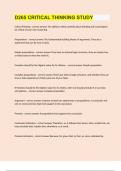
D265 Critical Thinking Study|2023/24 Update|Graded A+
Critical Thinking The ability to think carefully about thinking and reasoning/to be critical of your own reasoning. Propositions The fundamental building blocks of arguments. They are a statement that can be true or false. Simple propositions They have no internal logic structure, they are simply true or false based on how the world is. Freedom should be the highest value for its citizens. Simple proposition Complex propositions They have internal logic structure, and whether they are true or false depends on if their parts are true or false. If freedom should be the highest value for its citizens, then we should promote it in our laws and policies. Complex proposition Argument Contains at least two statements or propositions: a conclusion and one or more premises that lend support to the conclusion. Premise A proposition that supports the conclusion. Conclusion Indicators Therefore, so, it follows that, hence, thus, entails that, we may conclude that, implies that, wherefore, as a result. Premise Indicators Because, for, given that, in that, as, since, indicated by. Conclusion The claim that the whole argument is intended to support or prove. Deduction Arguments where the premises guarantee or necessitate the conclusion. Types of arguments that are deductive Mathematical arguments, logical arguments, arguments from definition. Induction Arguments where the premises make the conclusion likely to be true. Types of arguments that are inductive/ampliative Analogies, authority, casual inferences, scientific reasoning, extrapolations. P1: Monty is in Bejing P2: It is impossible to get here from Bejing in an afternoon Conclusion: Monty won't be at the party Deductive argument P1: Monty is really shy P2: Monty rarely goes to parties Conclusion: Monty won't be at the party Inductive/ampliative argument Soundness/Validity Elements of a deductive argument Validity If true, the premises make the conclusion true Soundness The argument's premises guarantee the conclusion when true (Validity), and all premises are true Strength/Cogency Elements of an inductive argument Strength The premises give probable support for the conclusion. Cogent The premises give probable support towards the conclusion when true (Strength), and all premises are true Fallacy A defect in reasoning Formal Fallacy A defect in the structure of an argument Informal Fallacy A defect in the content of an argument Modus Ponens (Affirming the Antecedent) basic structure P1. If X, then Y P2. X C: Therefore, Y No Formal Fallacy P1. If I'm in Rome, then I'm in Italy P2. I am in Rome. C: Therefore, I am in Italy Modus Ponens (Affirming the Antecedent)
Document information
- Uploaded on
- August 30, 2023
- Number of pages
- 10
- Written in
- 2023/2024
- Type
- Exam (elaborations)
- Contains
- Questions & answers


