NURS 3381 OB ATI Study Guide (100%Correct) Solutions.
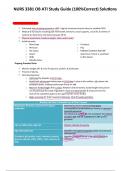
NURS 3381 OB ATI Study Guide (100%Correct) Solutions. Estimated date of delivery based on LMP. Vaginal ultrasound may be done to establish DOD Medical & nursing hx including past med health, family hx, social supports, social hx, & review of systems (to determine risk factors) & past OB hx Physical assessment: baseline weight, vitals, pelvic exam Initial lab work: o Blood type o RH factor o HIV status o Hep B o VDRL o Rubella status o Urinalysis o Pap o Indirect Coomb’s test will determine if client is sensitized to RH+ blood Ongoing Prenatal Visits: Monitor weight, BP, & urine for glucose, protein, & leukocytes Present of edema Fetal development: o FHR heard by Doppler at 10-12 wks o Heard with ultrasound stethoscope at 16-20 wks. Listen at the midline, right above the symphysis pubis, holding stethoscope firmly on abd o Measure fundal height after 12 wks. Between 18 & 30 weeks, fundal height measured in cm should equal the week of gestation. Have pt empty bladder & measure from the level of the symphysis pubis to the upper border of the fundus o Begin assessing for fetal movement between 16 & 20 weeks gestation Routine Lab Tests in Prenatal Care & Their Purpose Blood type, Rh factor, presence of irregular antibodies Determines risk for maternal-fetal blood incompatibility (erythroblastosis fetalis) or neonatal hyperbilirubinemia. For clients are are Rh(-) & not sensitized, the indirect Coombs’ test will be repeated b/t 24-28 weeks gestation CBC w/ differential, Hgb, Hct Detects infection & anemia Hgb electrophoresis Identifies hemoglobinopathies (sickle cell anemia & thalassemia) Urinalysis: pH, gravity, color, sediment, protein, glucose, albumin, RBCs, WBCs, casts, acetone, & HCG Identifies DM, gestational HTN, renal disease, & infection lOMoARcPSD| - 2 1 hr Glucose Tolerance (oral/IV admin of concentrated glucose w/ venous sample taken 1 hr later. Fasting not necessary) Identifies hyperglycemia; done at initial visit for atrisk clients, & at 24-28 wks for all pregnant women (140 requires follow up) 3 hr Glucose Tolerance (fasting overnight prior to oral or IV admin of concentrated glucose with a venous sample taken at 1, 2, & 3 hrs later) Used in clients w/ elevated 1-hr glucose tst as a screening tool for DM. A dx of GD requires 2 elevated blood-glucose readings Pap Test Screens for cervical cancer, HSV II, &/or HPV Vaginal/Cervical Culture Detects streptococcus B-hemolytic, Group B (routinely done at 35-37 wks), BV, STDS (gonorrhea, chlamydia) Rubella Titer Determines immunity to rubella. If non-immune, give shot! PPD, chest screening after 20 weeks w/ + purified protein derivative Identifies exposure to TB Hep B Screen Identifies carriers of hep B VDRL Syphilis screening mandated by law HIV Detects HIV infection: recommended for all clients who are pregnant unless client refuses testing TORCH (Toxoplasmosis, other infections, rubella, cytomegalovirus, & herpes) when indicated Screening for group of infections capable of crossing the placenta & adversely affecting fetal development Maternal serum alpha-fetoprotein (MSAFP) Between 15-22 wks Rhogam Administration: IM around 28 weeks for clients who are Rh (-) For amniocentesis, car wreck, or any instance of possibility of fetal/maternal blood mixture Health Promotion: Avoid all OTC meds, supplements, & rx meds unless OB who is supervising care has knowledge of this practice Alcohol (birth defects) & tobacco (low birth weight) contraindicated during pregnancy Substance abuse of any kind is to be avoid during pregnancy & lactation Encourage flu vaccine during the fall months lOMoARcPSD| I toxoplasmosis Other infections Rubella Cytomegalovirus Herpes 3- 3 Treat current infections Ascertain maternal exposure to hazardous materials Avoid use of hot tubs/saunas Consume at least 2-3 L of h20 daily from food & beverage sources Exercise: moderate exercise (walking/swimming) consisting of 30 minutes; no new exercise during pregnancy Third Trimester Childbirth Prep: Breathing & relaxation techniques o Deep cleansing breaths at ½ the usual respiratory rate during ctxns can promote relaxation of the abd muscles, which lessens the discomfort of uterine ctxns. discussion regarding pain management during labor & birth (natural child birth, epidural) Fetal movement/kick counts to ascertain fetal well-being. Client should be instructed to count & record fetal movements or kicks daily o It is recommended that mothers count fetal activity 2-3 x/day for 60 mins each time o Fetal movements 3/hr or movements that cease entirely for 12 hours need further eval Common Discomforts During Pregnancy: Morning sickness: eat cracker or dry toast ½ to 1 hr before rising in the morning to prevent discomfort. Avoid an empty stomach & drink fluids between meals. UTIs are common due to renal changes & vaginal flora becoming more alkaline o Wipe front to back, avoid bubble baths, wear cotton panties, avoid tight-fitting pants, & consume 8 glasses of water/day o Urinate as soon as urge occurs Constipation may occur during 2nd & 3rd trimesters. Drink plenty of fluids, eat a diet high in fiber, exercise regularly Leg cramps may occur during 3rd trimester d/c compression of lower extremity nerves & blood vessels by the enlarging uterus o Homan’s sign should be checked o If negative, patient should extend the affected leg, keeping knee straight & dorsiflexing the foot (toes toward the head) o Massaging & applying heat over affected muscle or a foot massage while the leg is extended can help relieve cramping o Notify PCP if frequent cramping occurs Varicose veins & extremity edema during 2nd & 3rd trimesters o Rest w/ legs elevated o Avoid constricting clothing o Wear support hose o Avoid sitting or standing in one position for long periods of time o Avoid sitting w/ legs crossed at knees o Sleep in left lateral position lOMoARcPSD| = - - 4 Gingivitis, nasal stuffiness, & epistaxis can occur Braxton Hicks ctxns o Should subside with change of position & walking .
Document information
- Uploaded on
- August 30, 2023
- Number of pages
- 26
- Written in
- 2023/2024
- Type
- Exam (elaborations)
- Contains
- Questions & answers