LATEST BUSINESS ENVIRONMENT AND CONCEPTS TEST BANK
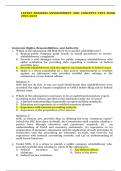
Corporate Rights, Responsibilities, and Authority 1. Which of the subsequent did SOX NOT do to protect whistleblowers? A. Require public company audit boards to install procedures to receive whistleblowers’ complaints. B. Provide a civil damages action for public company whistleblowers who suffer retaliation for providing data regarding a violation of federal securities laws. C. Provide whistleblowers with the right to sue immediately in federal court. D. Make it a crime punishable by a fine and/or imprisonment to retaliate against an informant who provides truthful data relating to the commission of any federal offense. Solution: C SOX did not do this. It was not until Dodd-Frank that whistleblowers were accorded the right to bypass complaints to OSHA before filing suit in federal district court. 2. Which of the subsequent is necessary to be an audit board monetary expert, according to the criteria specified in the Sarbanes-Oxley Act of 2002? A. A limited understanding of generally accepted auditing standards. B. Education and experience as a certified monetary planner. C. Experience with internal accounting controls. D. Experience in the preparation of tax returns. Solution: C SOX, in Section 407, provides that, in defining the term “monetary expert” (which the SEC have done in detail), the Commission shall consider whether a person have through education and experience acquired: (1) an understanding of GAAP and monetary statements; (2) experience in (a) preparation of monetary statements and (b) application of such principles in connection with the accounting for estimates, accruals, and reserves; (3) experience with internal accounting controls; and (4) an understanding of audit board functions. 3. Under SOX, it is a crime to punish a public company whistleblower who provides truthful data relating to which of the subsequent: A. Federal securities law violations. B. Federal tax law violations. C. Any federal offense. D. None of the above. Solution: C Whereas the SOX retaliation cause of action relates to whistleblowing about federal securities law violations only, the SOX provision that makes it a crime to retaliate against a whistleblower relates to whistleblowing regarding commission of any federal offense. 4. Dan provided original data to authorities regarding a securities fraud in his company. It led the SEC to impose penalties of $2 million. Which of the subsequent is most likely to be Dan’s award under Dodd-Frank? A. $50,000. B. $150,00 0. C. $350,00 0. D. $750,00 0 Solution: C This amount is within the range of mandatory awards, between 10% and 30% of sanctions imposed. 5. Mar have been complicit in her public company’s accounting fraud. She consults a lawyer as the time comes to file her firm’s 10-K with the SEC. She is a little uncomfortable with what she might have to do. The lawyer will likely tell her that she will have to certify (and be potentially criminally liable for lying about) these matters: A. That she have reviewed the 10-K. B. That to her knowledge the 10-K does not contain any materially untrue statements. C. That she, along with the CEO, is responsible for establishing and maintaining her company’s internal controls. D. All of the above. Solution: D All three of the previous decisions are examples, and not the only examples, ofthings that Mar must certify when her firm files a 10-K. 6. Public company audit boards must contain which of the subsequent? A. A majority of independent directors B. An accounting expert C. A monetary expert D. A legal expert Solution: C SOX requires that every audit board of a public company have at least one “monetary expert” with (a) an understanding of GAAP and monetary statements; (b) experience in preparing or auditing F/S; (c) experience with internal auditing controls; and (d) an understanding of audit board functions. 7. A public company audit board’s “monetary expert” must have all of the subsequent except: A. An understanding of GAAP and monetary statements. B. Experience in preparing or auditing monetary statements of comparable companies and application of such principles in connection with accounting for estimates, accruals, and reserves. C. Experience with internal auditing controls. D. Experience on a public company’s compensation board. Solution: D
Document information
- Uploaded on
- August 24, 2023
- Number of pages
- 218
- Written in
- 2023/2024
- Type
- Exam (elaborations)
- Contains
- Questions & answers