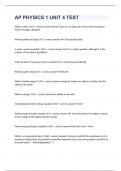
Ap Physics 1 Unit 4 Test
What is work? (ch7) - correct answer Work is done on an object by a force when the object moves through a distance. Work equation (no trig) (ch7) - correct answer W= F(vector)d(vector) Is work a vector quantity? (ch7) - correct answer No (it is a scalar quantity, although it is the product of two vector quantities) Scalar product of any two vectors A and B (ch7) - correct answer ABcosθ Work equation (trig) (ch7) - correct answer W=Fdcosθ What is kinetic energy? (ch7) - correct answer energy of motion (an object in motion has the ability to do work) What is energy? (ch7) - correct answer the ability to do work (Translational) kinetic energy equation (ch7) - correct answer K=½mv² Work-energy principle (words) (ch7) - correct answer The net work done on an object is equal to the change in the object's kinetic energy Work-energy principle (equation) (ch7) - correct answer Wnet=∆K=½mv₁²-½mv₂² What is a conservative force? (ch8) - correct answer (A force for which) the work done by it in moving an object from one position to another depends only on the two positions and NOT on the path taken (**Path independent**) What is the difference, other than the definition, between conservative forces such as mechanical energy and non conservative forces such as friction? (ch8) - correct answer The work done by a conservative force is recoverable What is potential energy? (ch8) - correct answer Energy associated with conservative forces that depend on the position or configuration of objects Gravitational potential energy equation (ch8) - correct answer Ugrav=mgh (h=height above some reference point) Elastic potential energy equation (ch8) - correct answer U=½kx² what is the x in the elastic potential energy equation? (ch8) - correct answer distance from its natural (unstretched/uncompressed) length Mechanical energy symbol and definition (ch8) - correct answer E is the sum of kinetic and potential energies Law of conservation of energy definition (ch8) - correct answer the total energy of a system is always conserved When is mechanical energy conserved (within a system) ? (ch8) - correct answer when only conservative forces act in that system What is power? (2 defs) (ch8) - correct answer the rate at which work is done, or the rate at which energy is transformed from one form to another Power equation (ch8) - correct answer P= F(vector)v(vector) Newton's First Law of Motion (Law of inertia) - correct answer if the net force on an object is zero, then an object originally at rest remains at rest and an object in motion remains in motion in a straight line with constant velocity Newton's Second Law of Motion - correct answer the acceleration of an object is directly proportional to the net force acting on it, and inversely proportional to the mass (∑F=ma) Newton's Third Law of Motion - correct answer whenever one object exerts a force on a second object, the second object always exerts a force on the first object that is equal in magnitude but opposite in direction Linear momentum (equation) (ch9) - correct answer p(vector)=mv(vector) Is momentum a vector quantity? (ch9) - correct answer yes Law of conservation of momentum (ch9) - correct answer the total momentum of an isolated system of objects remains constant impulse (symbol and definition) (ch9) - correct answer J, change in momentum (pfinal-pinitial) elastic collision (definiton) (ch9) - correct answer a collision in which kinetic energy is conserved is impulse a vector quantity? (ch9) - correct answer yes What is the result of a completely inelastic collision? (ch9) - correct answer the colliding objects stick together What is the unit for K? - correct answer N/m What is a Joule? - correct answer Nm What unit is momentum in? - correct answer Ns What are watts? - correct answer Joules per second
Document information
- Uploaded on
- August 11, 2023
- Number of pages
- 4
- Written in
- 2023/2024
- Type
- Exam (elaborations)
- Contains
- Questions & answers