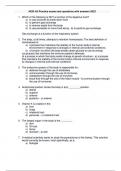
HESI A2 Practice exams test questions with answers 2023
1. Which of the following is NOT a function of the digestive tract? a) to use enzymes to break down food b) to perform gas exchange c) to remove waste from the body d) to use peristalsis to move food along - b) to perform gas exchange Gas exchange is a function of the respiratory system 2. The body, at all times, attempts to maintain homeostasis. The best definition of homeostasis is: a) a process that maintains the stability of the human body's internal environment in response to changes in internal and external conditions b) a function via which the body breaks down glucose to use as energy c)a process that maintains the immune system's defenses d) a process in which the body resists change to genetic structure - a) a process that maintains the stability of the human body's internal environment in response to changes in internal and external conditions 3. The endocrine system of the body is responsible for: a) defense through the use of antibodies b) communication through the use of hormones c) metabolism through the use of enzymes d) blood flow through the use of the heart muscle - b) communication through the use of hormones 4. Anatomical position shows the body in a(n) ________ position. a) lateral b) superior c) anterior d) posterior - c) anterior 5. Vitamin K is created in the: a) liver b) lungs c) intestinal tract d) pancreas - c) intestinal tract 6. The largest organ in the body is the ________. a) skin b) GI tract c) femur d) stomach - a) skin 7. A medical scientists wants to study the parenchyma of the kidney. This scientist would correctly be known, most specifically, as a: a) biologist b) doctor c) anatomist d) histologist - d) histologist Histology is the study of tissues. 8. What is Erythropoiesis? a) red blood cell formation b) white blood cell formation c) the destruction of red blood cells d) the destruction of white blood cells - a) red blood cell formation Blood cell formation is called Hemopoiesis. Erythro- red blood cells 9. In which part of the body is keratin NOT found? a) hair b) skin c) nails d) teeth - d) teeth Keratin is a family of fibrous structural proteins. Keratin is the key structural component of hair, nails, and the outer layer of human skin 10. What is the relationship between sarcomeres and muscle cells? a) sarcomeres are muscle cells b) sarcomeres contain muscle cells c) muscle cells contain myofibrils, which in turn are made up of sarcomeres d) muscle cells contain sarcomeres, which in turn are made up of myofibrils - c) muscle cells contain myofibrils, which in turn are made up of sarcomeres 11. A person who has torn their vastus lateralis muscle will need which of the following? a) an arm sling b) a cane or crutches c) insulin d) a neck brace - b) a cane or crutches The vastus lateralis muscle is a voluntary muscle in the legs. It is part of the quadriceps. 12. Muscles produce contraction due to the sliding of: a) filaments b) sarcomeres c) flexors d) neutrons - a) filaments During muscle contraction, filaments slide together by using energy supplied by ATP. 13. The medulla oblongata has what primary responsibility? a) balance b) intellect c) vital functions d) sensory input - c) vital functions The medulla oblongata is responsible for basic vital functions, including respiration and heart rate. 14. Which of the following is true about simple reflexes? a) they travel through the entire body b) they travel only through the spinal cord c) they travel only through the brain d) they do not travel and remain localized - b) they travel only through the spinal cord Simple reflexes, known also as spinal reflexes, travel only through the spinal cord, and do not reach the brain. 15. What is the primary role of estrogen in the female reproductive system? a) it initiates the preparation of the endometrium for pregnancy b) it triggers the release of the egg from the ovary c) it causes fertilization d) it triggers the production of breast milk - a) it initiates the preparation of the endometrium for pregnancy What is the name of the structure that transfers urine from the kidneys to the bladder? - -ureters 16. Humans can survive most easily without which of the following? a) pancreas b) lungs c) gallbladder d) bladder - c) gallbladder The gallbladder's function is to store bile, but the GI tract is more than capable of producing bile to digest fat without it
Document information
- Uploaded on
- August 9, 2023
- Number of pages
- 7
- Written in
- 2023/2024
- Type
- Exam (elaborations)
- Contains
- Questions & answers