

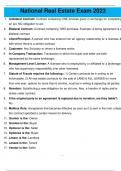
National Real Estate Exam 2023
1. Unilateral Contract: Contract containing ONE promise given in exchange for completing
an act. NO obligation to act.
2. Bilateral Contract: Contract containing TWO promises. Example: A listing agreement is a
bilateral contract
3. Client/Principal: A person who has entered into an agency relationship w/ a licensee &
with whom there is a written contract
4. Customer: Any 3rd party w/ whom a licensee works
5. In-Company Transaction: Transaction in which the buyer and seller are both
represented by the same brokerage.
6. Management-Level License: A licensee who is employed by or affiliated w/ a brokerage
who has supervisory responsibility over other licensees.
7. Statute of Frauds requires the following:: 1) Certain contracts be in writing to be
enforceable, 2) All real estate contracts for the sale of LAND & ALL LEASES for more
than one year, options for more than 6 months, must be in writing & signed by all parties.
8. Novation: Substituting a new obligation for an old one. Also, a transfer of rights and/or
duties under contract.
9. If the original party to an agreement is replaced due to novation, are they liable?:
No
10. Mailbox Rule: Acceptance that becomes effective as soon as it is sent in the mail, unless
the contract specified a certain means for delivery.
11. Grantor is the: Owner
12. Grantee is the: Buyer
13. Optionor is the: Seller
14. Optionee is the: Buyer
15. Lessor is the: Landlord
16. Lessee is the: Tenant
17. Vendor is the: Seller
, 18. Vendee is the: Buyer
19. Mortgagor is the: Buyer
20. Mortgagee is the: Lender
21. Trustor is the: Buyer
22. Trustee is the: 3rd Party to the transaction
23. Regulation Z dictates: Disclosure Requirements in Credit Transactions, including the
disclosure of the Annual Percentage Rate (APR)
24. Regulation Z applies to:: ALL REAL ESTATE credit transactions except for commercial
loans. For non-real estate transactions, it covers up to $25,000.
25 The Cooling Off Period is a condition of:: Regulation Z. It gives the customer the
right to rescind the transaction for up to 3 business days following the transaction for liens
placed on a principal residence.
26. RESPA stands for: Real Estate Settlement Procedures Act
27. RESPA requirements include:: 1) Lenders must give borrowers a good faith estimate of
closing costs.
2) Lenders must give borrowers a HUD booklet describing closing costs, settlement
procedures & borrowers rights.
3) Closing agent must prepare a HUD stmt detailing how much was paid to what companies
for what services
4) Borrower must be given right to inspect HUD stmt 1 day before close.
5) Lenders & other parties must give full disclosure of all business relationships.
6) Lender must disclose to borrower if the loan is likely to be sold to another investor.
28. RESPA prohibits:: 1) Kickbacks & fees for services not performed in connection w/
the closing
2) It limits the amount of escrow reserves a lender can hold
3) The sale may not be on the condition on the use of a certain title co or escrow co. chosen
by the seller.
1. Unilateral Contract: Contract containing ONE promise given in exchange for completing
an act. NO obligation to act.
2. Bilateral Contract: Contract containing TWO promises. Example: A listing agreement is a
bilateral contract
3. Client/Principal: A person who has entered into an agency relationship w/ a licensee &
with whom there is a written contract
4. Customer: Any 3rd party w/ whom a licensee works
5. In-Company Transaction: Transaction in which the buyer and seller are both
represented by the same brokerage.
6. Management-Level License: A licensee who is employed by or affiliated w/ a brokerage
who has supervisory responsibility over other licensees.
7. Statute of Frauds requires the following:: 1) Certain contracts be in writing to be
enforceable, 2) All real estate contracts for the sale of LAND & ALL LEASES for more
than one year, options for more than 6 months, must be in writing & signed by all parties.
8. Novation: Substituting a new obligation for an old one. Also, a transfer of rights and/or
duties under contract.
9. If the original party to an agreement is replaced due to novation, are they liable?:
No
10. Mailbox Rule: Acceptance that becomes effective as soon as it is sent in the mail, unless
the contract specified a certain means for delivery.
11. Grantor is the: Owner
12. Grantee is the: Buyer
13. Optionor is the: Seller
14. Optionee is the: Buyer
15. Lessor is the: Landlord
16. Lessee is the: Tenant
17. Vendor is the: Seller
, 18. Vendee is the: Buyer
19. Mortgagor is the: Buyer
20. Mortgagee is the: Lender
21. Trustor is the: Buyer
22. Trustee is the: 3rd Party to the transaction
23. Regulation Z dictates: Disclosure Requirements in Credit Transactions, including the
disclosure of the Annual Percentage Rate (APR)
24. Regulation Z applies to:: ALL REAL ESTATE credit transactions except for commercial
loans. For non-real estate transactions, it covers up to $25,000.
25 The Cooling Off Period is a condition of:: Regulation Z. It gives the customer the
right to rescind the transaction for up to 3 business days following the transaction for liens
placed on a principal residence.
26. RESPA stands for: Real Estate Settlement Procedures Act
27. RESPA requirements include:: 1) Lenders must give borrowers a good faith estimate of
closing costs.
2) Lenders must give borrowers a HUD booklet describing closing costs, settlement
procedures & borrowers rights.
3) Closing agent must prepare a HUD stmt detailing how much was paid to what companies
for what services
4) Borrower must be given right to inspect HUD stmt 1 day before close.
5) Lenders & other parties must give full disclosure of all business relationships.
6) Lender must disclose to borrower if the loan is likely to be sold to another investor.
28. RESPA prohibits:: 1) Kickbacks & fees for services not performed in connection w/
the closing
2) It limits the amount of escrow reserves a lender can hold
3) The sale may not be on the condition on the use of a certain title co or escrow co. chosen
by the seller.


