

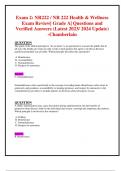
Exam 2: NR222 / NR 222 Health & Wellness Exam Review| Grade A| Questions and Verified Answers (Latest 2023/ 2024 Update) -Chamberlain
Exam 2: NR222 / NR 222 Health & Wellness Exam Review| Grade A| Questions and Verified Answers (Latest 2023/ 2024 Update) -Chamberlain QUESTION The point of the ethical principal to "do no harm" is an agreement to reassure the public that in all ways the health care team not only works to heal patients but agree to do this in the least painful and harmful way possible. Which principle describes this agreement? A. Beneficence B. Accountability C. Nonmaleficence D. Respect for autonomy Answer: C. Nonmaleficence Nonmaleficence refers specifically to the concept of avoiding harm. Beneficence refers more to generosity and goodness, accountability to keeping promises, and respect for autonomy to the commitment by providers to include patients in decisions about all aspects of care. QUESTION A child's immunization may cause discomfort during administration, but the benefits of protection from disease, both for the individual and society, outweigh the temporary discomforts. Which principle is involved in this situation? A. Fidelity B. Beneficence C. Nonmaleficence D. Respect for autonomy Answer: B. Beneficence The immunization is a clear effort to provide benefit. Beneficence refers to "doing good." Fidelity refers more to keeping promises. Nonmaleficence refers to the commitment to avoid harm. Respect for autonomy refers to the commitment to include patients in the decision-making process regarding health care plans. QUESTION When a nurse assesses a patient for pain and offers a plan to manage the pain, which principal is used to encourage the nurse to monitor the patient's response to the pain? A. Fidelity B. Beneficence C. Nonmaleficence D. Respect for autonomy Answer: A. Fidelity Requiring a return to the patient to evaluate the effectiveness of an intervention exemplifies keeping a promise, a concrete example of fidelity. QUESTION What is the best example of the nurse practicing patient advocacy? A. Seek out the nursing supervisor in conflicting procedural situations B. Document all clinical changes in the medical record in a timely manner C. Work to understand the law as it applies to an error in following standards of care D. Assess the patient's point of view and prepare to articulate it Answer: D. Assess the patient's point of view and prepare to articulate it Seeking out the nursing supervisor, documenting clinical change in the medical record in a timely manner and working to understand the law as it applies to an error in following standards of care are not wrong; but advocacy generally refers to the nurse's ability to help speak for the patient. QUESTION Successful ethical discussion depends on people who have a clear sense of personal values. When a group of people share many of the same values, it may be possible to refer for guidance to philosophical principals of utilitarianism. This philosophy proposes which of the following? A. The value of something is determined by its usefulness to society. B. People's values are determined by religious leaders. C. The decision to perform a liver transplant depends on a measure of the moral life that the patient has led so far. D. The best way to determine the solution to an ethical dilemma is to refer the case to the attending physician or health care provider. Answer: A. The value of something is determined by its usefulness to society. Utilitarianism specifically refers to the greatest good for the greatest number of people, whereas goodness is determined primarily by usefulness. The concept is easier to apply in a community where shared values allow for agreement about a definition of usefulness. QUESTION The philosophy sometimes called the ethics of care suggests that ethical dilemmas can best be solved by attention to which of the following? A. Patients B. Relationships C. Ethical principles D. Code of ethics for nurses Answer: B. Relationships The foundation of the ethics of care is its attention to relationships, as distinguished from other more principal based philosophies.
Document information
- Uploaded on
- August 3, 2023
- Number of pages
- 27
- Written in
- 2023/2024
- Type
- Exam (elaborations)
- Contains
- Questions & answers


