

Final Exam : NR222 / NR 222 Health & Wellness Exam Review | Grade A| Questi ons and Verified Answers (2023/ 2024 Update) Q: After a class on Pender's health promotion model, students make the following statements. Which statement does the faculty member need to clarify? Answer: "Perceived self -efficacy is not related to the model." Within the model, perceived self -efficac y is one of the behavior -specific cognitions and affect. The behavior -specific cognitions have motivational significance within the model. Q: * Traditional Chinese medicine (TCM) is used by many patients. Which statement most accurately describes interv ention(s) offered by TCM providers? Answer: Uses many modalities based on the individual's needs. TCM practitioners use a variety of interventions that are based on individual patient assessment findings and needs. Modalities include herbal therapies, a cupuncture, moxibustion, cupping, prescribed exercise such as tai chi or Q: * Which complementary therapies are most easily learned and applied by a nurse? Answer: Progressive relaxation. Breathwork and guided imagery. These were identified as nurse -accessible complementary therapies. Massage therapists are licensed by local governmental agencies, and additional educational preparation is required to practice. Traditional Chinese medicine practitioners also attend training/educational programs, typica lly accredited by the Accreditation Commission for Acupuncture and Oriental Medicine. Q: * Which statement best describes the evidence associated with complementary therapies as a whole? Answer: The science supporting the effectiveness of complementary therapies is early in its development. Science in the field is just beginning. Before the 1990s little attention was paid in the United States at the National Institutes of Health to support funding for studies about complementary therapies. Most of the evidence cited in systematic reviews throughout this chapter indicates preliminary suppo rt for the effectiveness of a variety of complementary therapies. Conditions that appear to be particularly responsive include chronic pain, chronic autoimmune disorders, anxiety, depression, impaired well -being and quality of life that accompany cancer an d other chronic conditions, and some time -limited acute illnesses and the symptoms that accompany them (e.g., gastrointestinal disturbances, colds/flus). Q: * A nurse is planning care for a group of patients who have requested the use of complementary h ealth modalities. Which patient is not a good candidate for guided imagery? Answer: Patient with posttraumatic stress disorder (PTSD). Imagery can often recreate the traumatic experience, intensifying the sensations and emotions that accompany the memor y of it and bringing the PTSD to a crisis level. Q: * Several nurses on a busy unit are using relaxation strategies while at work. What is the desired workplace outcome from this intervention? Answer: Improved staff satisfaction. Improved staff relati onships. Current research has been able to determine that reducing stress by using relaxation strategies in the workplace leads to improved staff relationships, communication, and satisfaction. Q: * The nurse manager of a community clinic arranges for staff in -services about various complementary therapies available in the community. What is the purpose of this training? Answer: Nurses have a long history of providing some of these therapies and need to be knowledgeable about their positive outcomes. Nurses are often asked for recommendations and strategies that promote well -being and quality of life. Nurses play an essential role in patient education to provide information about the safe use of these healing strategies. Nurses appreciate the cultural aspects of care and recognize that many of these complementary strategies are part of a patient's life. Nurses play an essential role in the safe use of complementary therapies. All of the statements are true except that nurses do not learn how to provide all of th e complementary modalities during their basic education. Nurses play an essential role in the safe use of complementary therapies in our emerging health care system. They have an appreciation for many types of interventions and can understand the patient's need to become more involved in his or her health care decisions and choices. They also understand the patient's desire to take a more active role in his or her healing and health promotion processes. Culturally relevant care that uses a full complement o f intervention strategies that are supported with evidence is a central tenet of contemporary nursing practice. Q: A patient who has been using relaxation wants a better response. The nurse recommends the addition of biofeedback. What is the expected ou tcome related to using this additional modality? Answer: To learn how to control some autonomic nervous system responses. Biofeedback is a mind -body technique that teaches self -regulation and voluntary control over specific physiological responses, incl uding autonomic nervous system response. Q: A nursing professor is teaching a nursing student about caring patients who use herbal preparations in addition to prescribed medications. Which of the following statements made by the student indicates that t he student understands herbal preparations? Answer: "We need to treat herbal preparations as though they are "drugs" because many have active ingredients that can interact with other medications and change physiological responses." Herbal therapies are derived from plant materials and often contain the sam e active components as medications. Yet they are viewed as dietary supplements and are not regulated by the FDA. You should always explicitly ask patients whether they are taking supplements or other herbal remedies or vitamins when you ask them about the medications that are currently being used during a health history. Many patients do not tell you about these products voluntarily because they do not view them as medications, they fear that conventional providers will not approve of these substances and t hey want to continue taking them, or they do not think that you are interested in a substance that was not prescribed. Q: Which of the following statements best explains the actions of therapeutic touch (TT)? Answer: Intentionally mobilizes energy to balance, harmonize, and repattern the recipient's biofield. TT is focused on healing the whole person and providing energy to the body that supports innate healing responses. The research literature is questionable; systematic analyses claim that the research designs are too weak for any conclusive evidence to be identified with confidence. Although TT is relatively safe and there have been very few negative events associated with its use, all therapies (complementary or conventional) should be used with c aution in certain populations. Q: Meditation may compound the effects of which of these medications? Answer: Antihypertensive and thyroid -regulating medications. Mind -body techniques, including meditation, create physiological responses in the cardio vascular and respiratory systems. These responses may include decreased blood pressure, reduced heart rate, and slowed respirations. They decrease the need for antihypertensive and other cardiac regulators and thyroid -regulating medications. Q: When planning patient education, it is important to remember that patients with which of the following illnesses often find relief in complementary therapies?
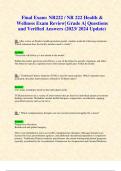
Preview 4 out of 66 pages
Exam (elaborations)
Final Exam: NR222 / NR 222 Health & Wellness Exam Review| Grade A| Questions and Verified Answers (2023/ 2024 Update)
Preview 4 out of 66 pages
Final Exam: NR222 / NR 222 Health & Wellness Exam Review| Grade A| Questions and Verified Answers (2023/ 2024 Update) Q: After a class on Pender's health promotion model, students make the following statements. Which statement does the faculty member need to clarify? Answer: "Perceived self-efficacy is not related to the model." Within the model, perceived self-efficacy is one of the behavior-specific cognitions and affect. The behavior-specific cognitions have motivational significance within the model. Q: * Traditional Chinese medicine (TCM) is used by many patients. Which statement most accurately describes intervention(s) offered by TCM providers? Answer: Uses many modalities based on the individual's needs. TCM practitioners use a variety of interventions that are based on individual patient assessment findings and needs. Modalities include herbal therapies, acupuncture, moxibustion, cupping, prescribed exercise such as tai chi or Q: * Which complementary therapies are most easily learned and applied by a nurse? Answer: Progressive relaxation. Breathwork and guided imagery. These were identified as nurse-accessible complementary therapies. Massage therapists are licensed by local governmental agencies, and additional educational preparation is required to practice. Traditional Chinese medicine practitioners also attend training/educational programs, typically accredited by the Accreditation Commission for Acupuncture and Oriental Medicine. Q: * Which statement best describes the evidence associated with complementary therapies as a whole? Answer: The science supporting the effectiveness of complementary therapies is early in its development. Science in the field is just beginning. Before the 1990s little attention was paid in the United States at the National Institutes of Health to support funding for studies about complementary therapies. Most of the evidence cited in systematic reviews throughout this chapter indicates preliminary support for the effectiveness of a variety of complementary therapies. Conditions that appear to be particularly responsive include chronic pain, chronic autoimmune disorders, anxiety, depression, impaired well-being and quality of life that accompany cancer and other chronic conditions, and some time-limited acute illnesses and the symptoms that accompany them (e.g., gastrointestinal disturbances, colds/flus). Q: * A nurse is planning care for a group of patients who have requested the use of complementary health modalities. Which patient is not a good candidate for guided imagery? Answer: Patient with posttraumatic stress disorder (PTSD). Imagery can often recreate the traumatic experience, intensifying the sensations and emotions that accompany the memory of it and bringing the PTSD to a crisis level. Q: * Several nurses on a busy unit are using relaxation strategies while at work. What is the desired workplace outcome from this intervention? Answer: Improved staff satisfaction. Improved staff relationships. Current research has been able to determine that reducing stress by using relaxation strategies in the workplace leads to improved staff relationships, communication, and satisfaction. Q: * The nurse manager of a community clinic arranges for staff in-services about various complementary therapies available in the community. What is the purpose of this training? Answer: Nurses have a long history of providing some of these therapies and need to be knowledgeable about their positive outcomes. Nurses are often asked for recommendations and strategies that promote well-being and quality of life. Nurses play an essential role in patient education to provide information about the safe use of these healing strategies. Nurses appreciate the cultural aspects of care and recognize that many of these complementary strategies are part of a patient's life. Nurses play an essential role in the safe use of complementary therapies. All of the statements are true except that nurses do not learn how to provide all of the complementary modalities during their basic education. Nurses play an essential role in the safe use of complementary therapies in our emerging health care system. They have an appreciation for many types of interventions and can understand the patient's need to become more involved in his or her health care decisions and choices. They also understand the patient's desire to take a more active role in his or her healing and health promotion processes. Culturally relevant care that uses a full complement of intervention strategies that are supported with evidence is a central tenet of contemporary nursing practice. Q: A patient who has been using relaxation wants a better response. The nurse recommends the addition of biofeedback. What is the expected outcome related to using this additional modality? Answer: To learn how to control some autonomic nervous system responses. Biofeedback is a mind-body technique that teaches self-regulation and voluntary control over specific physiological responses, including autonomic nervous system response. Q: A nursing professor is teaching a nursing student about caring patients who use herbal preparations in addition to prescribed medications. Which of the following statements made by the student indicates that the student understands herbal preparations? Answer: "We need to treat herbal preparations as though they are "drugs" because many have active ingredients that can interact with other medications and change physiological responses." Herbal therapies are derived from plant materials and often contain the same active components as medications. Yet they are viewed as dietary supplements and are not regulated by the FDA. You should always explicitly ask patients whether they are taking supplements or other herbal remedies or vitamins when you ask them about the medications that are currently being used during a health history. Many patients do not tell you about these products voluntarily because they do not view them as medications, they fear that conventional providers will not approve of these substances and they want to continue taking them, or they do not think that you are interested in a substance that was not prescribed. Q: Which of the following statements best explains the actions of therapeutic touch (TT)? Answer: Intentionally mobilizes energy to balance, harmonize, and repattern the recipient's biofield. TT is focused on healing the whole person and providing energy to the body that supports innate healing responses. The research literature is questionable; systematic analyses claim that the research designs are too weak for any conclusive evidence to be identified with confidence. Although TT is relatively safe and there have been very few negative events associated with its use, all therapies (complementary or conventional) should be used with caution in certain populations. Q: Meditation may compound the effects of which of these medications? Answer: Antihypertensive and thyroid-regulating medications. Mind-body techniques, including meditation, create physiological responses in the cardiovascular and respiratory systems. These responses may include decreased blood pressure, reduced heart rate, and slowed respirations. They decrease the need for antihypertensive and other cardiac regulators and thyroid-regulating medications. Q: When planning patient education, it is important to remember that patients with which of the following illnesses often find relief in complementary therapies?
Content preview
Document information
- Uploaded on
- July 29, 2023
- Number of pages
- 66
- Written in
- 2022/2023
- Type
- Exam (elaborations)
- Contains
- Questions & answers
$12.49
Wrong document? Swap it for free
Within 14 days of purchase and before downloading, you can choose a different document. You can simply spend the amount again.
Written by students who passed
Immediately available after payment
Read online or as PDF
Reputation scores are based on the amount of documents a seller has sold for a fee and the reviews they have received for those documents. There are three levels: Bronze, Silver and Gold. The better the reputation, the more your can rely on the quality of the sellers work.

