
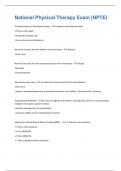
National Physical Therapy (NPTE) | 374 Questions and Answers(A+ Solution guide) 2023
List the functions of the skeletal system - -Supports and shape the body -Protects vital organs -Produced red blood cells -Stores calcium and phosphorus Name the muscles that the axillary nerve innervates - -Deltoids -Teres minor Name the muscles that the musculocutaneous nerve innervates - -Biceps -Brachialis -Coracobrachialis Sternoclavicualar joint - -Connects the clavicle and UE to the axial skeleton -plane joint -motions: elevation/depression, protraction/retraction, and rotation* (check book for accuracy) Scapulohumeral Rhythm - For every 2 degrees of GH flexion and abduction, there is a corresponding 2 degrees of scapular upward rotation -prevents impingement of supraspinatus -maintains length: tension relationship of muscles Explain the scale of Manual Muscle Testing (MMT): - -5: Normal, max resistance -4: Good, mod resistance -3: Fair, AROM AG -2: Poor, AROM GL -1: Trace, palpable/visible contraction-0: Absent What muscles make up the rotator cuff? - "SITS" muscles -Supraspinatus -Infraspinatus -Teres minor -Subscapularis Glenohumeral Joint - -approximation of the humeral head and glenoid fossa -ball and socket joint -3 degrees of freedom -high mobility low stability -most functional in scaption plane What muscles in the sternoclavicular joint limit motion? - -Anterior/Posterior sternoclavicular tendon limit ant/post translation -Costoclavicular tendon limits elevation -Interclavicular tendon limits depression List the types of bones: - -long: femur -short: trapezoid -flat: sternum -irregular: vertabrae -sesamoid: patella Rotator cuff - -comprised of 4 muscles ("SITS" muscles) -prevents the humeral head from rotating on the glenoid fossa
Document information
- Uploaded on
- July 29, 2023
- Number of pages
- 53
- Written in
- 2022/2023
- Type
- Exam (elaborations)
- Contains
- Questions & answers


