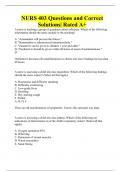
NURS 403 Questions and Correct Solutions| Rated A+
A nurse is teaching a group of guardians about influenza. Which of the following information should the nurse include in the teaching? A. "Amantadine will prevent the illness." B. "Rimantadine is administered intramuscularly." C. "Zanamivir can be given to children 1 year and older." D. "Oseltamivir should be given within 48 hours of onset of manifestations." D Oseltamivir decreases flu manifestations in clients who have findings for less than 48 hours A nurse is assessing a child who has epiglottitis. Which of the following findings should the nurse expect? (Select all that apply) A. Hoarseness and difficulty speaking B. Difficulty swallowing C. Low-grade fever D. Drooling E. Dry, barking cough F. Stridor A, B, D, F These are all manifestations of epiglottitis. I know, this rationale was dope. A nurse is assessing a child who has asthma. Which of the following are indications of deterioration in of the child's respiratory status? (Select all that apply). A. Oxygen saturation 95% B. Wheezing C. Retraction of sternal muscles D. Warm extremities E. Nasal flaring B, C, E Bronchoconstriction causes wheezing, which is an indicator of deterioration in a child's respiratory status. Increased work of breathing cause retraction of the sternal muscles, which is an indicator of deterioration in a child's respiratory status. Increased work of breathing causes nasal flaring, which is an indicator of deterioration in a child's respiratory status A nurse is teaching an adolescent about the appropriate use of his asthma medications. Which of the following medications should the nurse instruct the client to use as needed before exercise? A. Fluticasone/salmeterol B. Montelukast C. Prednisone D. Albuterol D Albuterol is a beta2 agonist used for bronchodilator. Instruct the adolescent the medicine is quick-acting, should be administered prior to exercise, and is used to provide immediate relief of bronchoconstriction. A nurse is planning care for a child who has asthma. Which of the following interventions should the nurse include in the plan of care? (Select all that apply). A. Perform chest percussion B. Place the child in an upright position C. Monitor oxygen saturation D. Administer bronchodilators E. Administer dornase alfa daily B, C, D Children who are experiencing an asthma exacerbation have decreased oxygenation. Place the child in an upright position to promote ventilation. Monitor oxygen saturation to detect changes in the child's condition. They also experience bronchoconstriction, so give a bronchodilator. This rationale was great. Suuuuuper worth my time to write it out... A nurse is discussing risk factors for asthma with a group of newly licensed nurses. Which of the following conditions should the nurse include in the teaching? (Select all that apply) A. Family history of asthma B. Family history of allergies C. Exposure to smoke D. Low birth weight E. Being underweight A, B, C, D These are all risk factors for development of asthma. A nurse in a PACU is admitting a client who is postoperative following a tonsillectomy. Which of the following actions should the nurse plan to take to prevent aspiration? A. Place a bedside humidifier at the head of the client's bed. B. Suction the nasopharynx as needed. C. Withhold fluids until the client demonstrates a gag reflex. D. Perform chest physiotherapy. C Following a tonsillectomy, the client's gag reflex can be suppressed by local anesthetics or edema. To prevent aspiration, the gag reflex must be present before the client is allowed have fluids. A nurse is caring for a toddler who has acute laryngotracheobronchitis and has been placed in a cool mist tent. Which of the following findings indicates that the treatment has been effective? A. Barking cough B. Improved hydration C. Decreased stridor D. Decreased temperature C Laryngotracheobronchitis, or croup, is a condition caused by an infection of the upper airway (larynx, trachea, and bronchus) and is characterized by a barking cough. Edema and obstruction in the upper airways cause the characteristic cough and stridor (noisy breathing). The direct purpose of a cool mist tent is to humidify the inspired air, which decreases respiratory effort. A nurse is planning care for a child who has suspected epiglottitis. Which of the following actions should the nurse take? A. Obtain a throat culture. B. Place the child in an upright position. C. Transport the child to radiology for a throat x-ray. D. Visualize the epiglottis with a tongue depressor. B Placing the child in an upright position will assist in maintaining a patent airway. A nurse is caring for a pre-school age child who has epiglottitis with a barking cough. Which of the following actions should the nurse take? A. Initiate airborne precautions. B. Obtain a throat culture. C. Use a tongue depressor to observe the epiglottis. D. Monitor oxygen saturation. D The nurse should monitor the child's oxygen saturation levels to check for indications of respiratory distress or a decline child's condition. A nurse is monitoring a child for manifestations of hemorrhage following a tonsillectomy. Which of the following findings is a manifestation of this postoperative complication? A. Mouth breathing B. Frequent swallowing C. Reports of thirst D. Reports of pain B Frequent swallowing and throat clearing are signs of hemorrhage after a tonsillectomy.
Document information
- Uploaded on
- July 27, 2023
- File latest updated on
- July 28, 2023
- Number of pages
- 39
- Written in
- 2022/2023
- Type
- Exam (elaborations)
- Contains
- Questions & answers