

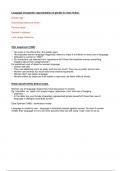
Language and gender: representation of gender in crime ction.
Golden age -
Hard-boiled detective ction-
Femme fatale-
Damsel in distress-
Lone ranger detective-
Otto Jesperson (1922)
- He works in the 20s & 30s ( the golden age )
- He evaluates women language negatively, seems to imply it is inferior to mens use of language
- Attitudes to women in 1922?
- Do characters use features from Jespersons list? Does this therefore convey something
negative about them pragmatically?
He published a set of ideas for women language
- women talk alot
- They use adjectives such as pretty and nice too much. They say so pretty and so nice.
- Women use adverbs too much and tend towards hyperbole.
- Women don’t use taboo language.
- Novels written by ladies are a lot easier to read and use fewer di cult words.
Robin lakeo (1970): De cit model.
Women use of language means they have less power in society.
Eg. Intensi er ‘so’ used a lot ‘empty/vague’ adjectives ‘nice’ and use of hedging
- politness
- In the data: are your female characters represented as less powerful? Does their use of
language in dialogue contribute to this?
Dale Spencer (1980) : dominance model
Language is made by men - language is inherently biased against women. So even if women
modify their language to try to be more powerful they are still using ‘male’ tools to do so.
fi ff fi fi fi ffi
Golden age -
Hard-boiled detective ction-
Femme fatale-
Damsel in distress-
Lone ranger detective-
Otto Jesperson (1922)
- He works in the 20s & 30s ( the golden age )
- He evaluates women language negatively, seems to imply it is inferior to mens use of language
- Attitudes to women in 1922?
- Do characters use features from Jespersons list? Does this therefore convey something
negative about them pragmatically?
He published a set of ideas for women language
- women talk alot
- They use adjectives such as pretty and nice too much. They say so pretty and so nice.
- Women use adverbs too much and tend towards hyperbole.
- Women don’t use taboo language.
- Novels written by ladies are a lot easier to read and use fewer di cult words.
Robin lakeo (1970): De cit model.
Women use of language means they have less power in society.
Eg. Intensi er ‘so’ used a lot ‘empty/vague’ adjectives ‘nice’ and use of hedging
- politness
- In the data: are your female characters represented as less powerful? Does their use of
language in dialogue contribute to this?
Dale Spencer (1980) : dominance model
Language is made by men - language is inherently biased against women. So even if women
modify their language to try to be more powerful they are still using ‘male’ tools to do so.
fi ff fi fi fi ffi


