NCLEX-PN 3000 Questions
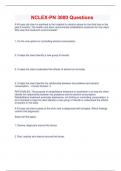
NCLEX-PN 3000 Questions A 40-year-old client is admitted to the hospital for alcohol abuse for the third time in the past 9 months. The health care team recommends rehabilitative treatment for this client. Why was this treatment recommended? 1. It's the only option for controlling alcohol consumption. 2. It helps the client identify a new group of friends. 3. It helps the client understand the effects of alcohol on his body. 4. It helps the client identify the relationship between his problems and alcohol consumption. - Correct Answer: 4 RATIONALES: The purpose of rehabilitative treatment in alcoholism is to help the client identify the relationship between his problems and his alcohol consumption. Rehabilitative treatment promotes abstinence, not limiting or controlling consumption. It isn't intended to help the client identify a new group of friends or understand the effects of alcohol on his body. A 42-year-old client comes to the clinic and is diagnosed with shingles. Which findings confirm this diagnosis? Select all that apply: 1. Severe, deep pain around the thorax 2. Red, nodular skin lesions around the thorax 3. Fever 4. Malaise 5. Diarrhea - Correct Answer: 1,2,3,4 RATIONALES: Shingles, also called herpes zoster, is an acute unilateral and segmental inflammation of the dorsal root ganglia. It's caused by infection with the herpes virus varicella-zoster, the same virus that causes chickenpox. It commonly causes severe, deep pain along a peripheral nerve on the trunk of the body and red, nodular skin lesions. Fever and malaise typically accompany these findings. Diarrhea doesn't commonly occur with shingles. A 43-year-old man was transferring a load of firewood from his front driveway to his backyard woodpile at 10 a.m. when he experienced a heaviness in his chest and dyspnea. He stopped working and rested, and the pain subsided. At noon, the pain returned. At 1:30 p.m., his wife took him to the emergency department. Around 2 p.m., the emergency department physician diagnoses an anterior myocardial infarction (MI). The nurse should anticipate which immediate order by the physician? 1. Lidocaine administration 2. Cardiac stress test 3. Serial liver enzyme testing 4. Tissue plasminogen activator (tPA) - Correct Answer: 4 RATIONALES: If 6 hours or less have passed since the onset of symptoms related to MI, thrombolytic therapy is indicated. (The client's chest pain began 4 hours before diagnosis.) The preferred choice is tPA. The client doesn't exhibit symptoms that indicate the use of lidocaine. Stress testing shouldn't be performed during the acute phase of an MI, but it may be ordered before discharge. Serial cardiac biomarkers, not serial liver enzymes, would be ordered for this client. A 76-year-old client is admitted to a long-term care facility with Alzheimer's-type dementia. The client has been wearing the same dirty clothes for several days. The nurse contacts the family and asks them to bring in clean clothing. Which intervention would bestprevent further regression in the client's personal hygiene?
Document information
- Uploaded on
- July 19, 2023
- Number of pages
- 53
- Written in
- 2022/2023
- Type
- Exam (elaborations)
- Contains
- Questions & answers