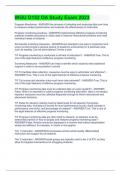
WGU D152 OA Study Exam 2023
Progress Monitoring - ANSWER-the process of collecting and analyzing data over time to measure student performance and evaluate the effectiveness of instruction Progress monitoring practices - ANSWER-Implementing effective progress monitoring practices enables educators to utilize data to improve instructional practices and meet individual needs of students. Schoolwide screening measures - ANSWER-are intended to be easy to implement and score yet still provide a general picture of academic achievement in a particular area, such as reading. Can be administered 3 times a year. T/F Progress monitoring is conducted in all tiers of instruction? - ANSWER-True, This is one of the eight features of effective progress monitoring. Screening Measures - ANSWER-can help to identify which students need additional support in order to be successful in school T/F To facilitate data collection, measures must be easy to administer and effective? - ANSWER-True, This is one of the eight features of effective progress monitoring. T/F Cut scores and decision rules must have clear rationale? - ANSWER-True, This is one of the eight features of effective progress monitoring. T/F Progress monitoring data must be collected daily on every student? - ANSWER-False, while it is important to collect progress monitoring data often, daily is not always required. measures must be collected frequently enough to inform instructional and placement decisions. T/F Rules for decision-making must be determined for all aspects of progress-monitoring data, including cut scores for level (performance score), slope (change in performance over time), and percentage of mastery? - ANSWER-True, This is one of the eight features of effective progress monitoring. T/F Progress monitoring data are often hard to interpret, so teachers must be extensively trained on how to display and interpret progress monitoring data? - ANSWER-False, Results should be displayed in a manner that makes interpretation simple and efficient, for example, in charts or line graphs. Tier 1 Instruction - ANSWER-Encompasses whole-school quality differentiated instruction and support for all students. Tier 2 Instruction - ANSWER-small groups are typically used in tier 2 of RTI, as they allow for targeted interventions for struggling students. Tier 3 Instruction - ANSWER-one on one. Require individualized goals. Their progress toward goals requires more frequent measuring to determine the effectiveness of the intervention Data-based Individualization (DBI) - ANSWER-A means of using evidence-based methods to individualize interventions for students who do not demonstrate adequate progress Sara was identified with a low level of performance in mathematics and has been receiving tier 1 supports. Her weekly progress monitoring showed that she continued to have a reduced rate of progress. What happens next with Sara, based on this result? - ANSWER-Student should be considered for tier 2 supports. T/F Curriculum-based measurements are an appropriate means to conduct progress monitoring. - ANSWER-True, Curriculum-based measurements allow teachers to track skills from an entire year's curriculum and monitor progress. Progress Monitoring - ANSWER-1. Easy to implement 2. Indicate how students are performing 3.Designed to be administered frequently Diagnostic Assessment - ANSWER-1. Determine why students are struggling to make progress 2. Determine the type of change that needs to be made 3. Make intervention adaptations that align with student needs How do you establish baseline data when creating a graph for progress monitoring? - ANSWER-Administer three probes or trials, select the median (the middle number), and then mark the score by placing a dot on the vertical axis (e.g., words correct per minute). Sophia was given a reading fluency probe. She read up to 84 words in the passage. However, she made several mistakes. Her mistakes included omitting two words, adding one word, and misreading several words: "can" instead of "come," "drive" instead of "driving," "lean" instead of "learn," and "also" instead of "too." True or False The two words that Sophia omitted and the word that Sophia added count as errors on this fluency probe. - ANSWER-True, Omitted words and added words are considered mistakes in assessing reading fluency. If students self-correct their mistakes, then these are not considered errors. So, if the student makes one or more attempts but finally corrects the word, there is no error.
Document information
- Uploaded on
- July 16, 2023
- Number of pages
- 11
- Written in
- 2022/2023
- Type
- Exam (elaborations)
- Contains
- Questions & answers