
• Wrong document? Swap it for free
  • Written by students who passed
  • Immediately available after payment
  • Read online or as PDF
Sell
Where do you study
Your language
Document preview thumbnail
Preview 2 out of 8 pages
Exam (elaborations)

PHYS- Waves Gizmo Questions And Answers

Document preview thumbnail
Preview 2 out of 8 pages

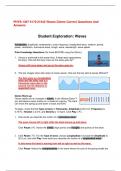
PHYS- Waves Gizmo Correct Questions And Answers Student Exploration: Waves Vocabulary: amplitude, compression, crest, frequency, longitudinal wave, medium, period, power, rarefaction, transverse wave, trough, wave, wavelength, wave speed Prior Knowledge Questions (Do these BEFORE using the Gizmo.) 1. A buoy is anchored to the ocean floor. A large wave approaches the buoy. How will the buoy move as the wave goes by? A buoy will move down and up as the wave goes by. 2. The two images show side views of ocean waves. How are the two sets of waves different? The first wave is a longitudinal wave and the other one is a transverse wave also in the second one the distance is separated more. Gizmo Warm-up Ocean swells are an example of waves. In the Waves Gizmo™, you will observe wave motion on a model of a spring. The hand can move the spring up and down or back and forth. To begin, check that the Type of wave is Transverse, Amplitude is 20.0 cm, Frequency is 0.75 Hz, Tension is 3.0 N, and Density is 1.0 kg/m. Click Play ( ). 1. How would you describe the motion of a transverse wave? The wave moves left to right while the hand moves up and down. Click Pause ( ). Notice the crests (high points) and troughs (low points) of the wave. 2. Click Reset ( ). For the Type of wave, choose Longitudinal. Increase the Amplitude to 20.0 cm, and click Play. How would you describe the motion of a longitudinal wave? In this wave the hand is moving from left to right as well as the wave. Click Pause. Notice the compressions in the wave where the coils of the spring model are close together and the rarefactions where the coils are spread apart. Question: How do we measure and describe waves? 1. Observe: Click Play. Observe the motions of the hand and of the green dot in the middle. A. What is the motion of the hand? Moves up and down. B. Turn off the Lights on checkbox and observe the green dot. What is the motion of the green dot? Moves up and down. C. Follow the motion of a single crest of the wave. How does the crest move? The crest moves from left to right. In a transverse wave, the motion of the medium (what the wave moves through—in this case, the spring) is perpendicular to the direction of the wave. So, each point of the spring moves up and down as the wave travels from left to right. 2. Measure: With the lights on, click Pause. Turn on Show rulers. A. Use the horizontal ruler to measure the horizontal distance between two crests. What is this distance? 100cm This is the wavelength of the wave. B. What is the distance between the two troughs? 100cm The wavelength can be found by measuring the distance between two successive crests, two successive troughs, or any two equivalent points on the wave. C. Click Reset. Set the Density to 1.0 kg/m. Click Play, and then Pause. What is the wavelength of this wave? 140cm 3. Measure: Click Reset. The amplitude of a transverse wave is the maximum distance a point on the wave is displaced, or moved, from its resting position. Turn off the lights. Click Play, and then click Pause. Use the vertical ruler to measure the height of the green trace, showing how far the green dot moved up and down. A. What is the height of the green trace? 40cm B. The wave’s amplitude is equal to half of this height. What is the amplitude? 20cm (Activity A continued on next page)

Content preview

PHYS-1307 6172-21542 Waves Gizmo Correct Questions And
Answers


Student Exploration: Waves

Vocabulary: amplitude, compression, crest, frequency, longitudinal wave, medium, period,
power, rarefaction, transverse wave, trough, wave, wavelength, wave speed

Prior Knowledge Questions (Do these BEFORE using the Gizmo.)

1. A buoy is anchored to the ocean floor. A large wave approaches
the buoy. How will the buoy move as the wave goes by?

A buoy will move down and up as the wave goes by.


2. The two images show side views of ocean waves. How are the two sets of waves different?

The first wave is a longitudinal
wave and the other one is a
transverse wave also in the
second one the distance is
separated more.


Gizmo Warm-up
Ocean swells are an example of waves. In the Waves Gizmo™,
you will observe wave motion on a model of a spring. The hand
can move the spring up and down or back and forth.

To begin, check that the Type of wave is Transverse, Amplitude is 20.0 cm, Frequency is
0.75 Hz, Tension is 3.0 N, and Density is 1.0 kg/m. Click Play ( ).

1. How would you describe the motion of a transverse wave?

The wave moves left to right while the hand moves up and down.

Click Pause ( ). Notice the crests (high points) and troughs (low points) of the wave.


2. Click Reset ( ). For the Type of wave, choose Longitudinal. Increase the Amplitude to
20.0 cm, and click Play. How would you describe the motion of a longitudinal wave?

In this wave the hand is moving from left to right as well as the wave.

Click Pause. Notice the compressions in the wave where the coils of the spring model are

, close together and the rarefactions where the coils are spread apart.

Document information

Uploaded on
July 8, 2023
Number of pages
8
Written in
2022/2023
Type
Exam (elaborations)
Contains
Questions & answers
$10.99

Wrong document? Swap it for free Within 14 days of purchase and before downloading, you can choose a different document. You can simply spend the amount again.
Written by students who passed
Immediately available after payment
Read online or as PDF

Sold
1
Followers
0
Items
577
Last sold
1 year ago


Why students choose Stuvia

Created by fellow students, verified by reviews

Quality you can trust: written by students who passed their tests and reviewed by others who've used these notes.

Didn't get what you expected? Choose another document

No worries! You can instantly pick a different document that better fits what you're looking for.

Pay as you like, start learning right away

No subscription, no commitments. Pay the way you're used to via credit card and download your PDF document instantly.

Student with book image

“Bought, downloaded, and aced it. It really can be that simple.”

Alisha Student

Working on your references?

Create accurate citations in APA, MLA and Harvard with our free citation generator.

Working on your references?

Frequently asked questions

