
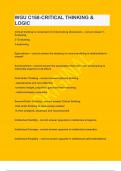
WGU C168-CRITICAL THINKING & LOGIC|UPDATED&VERIFIED|100% SOLVED|GUARANTEED SUCCESS
Critical thinking is comprised of 3 interlocking dimensions 1- Analyzing 2- Evaluating 3-Improving Egocentrism the tendency to view everything in relationship to oneself Sociocentrism the assumption that one's own social group is inherently superior to all others First-Order Thinking ordinary thinking - spontaneous and non-reflective -contains insight, prejudice, good and bad reasoning - indiscriminately combined Second-Order Thinking Critical thinking -first-order thinking is consciously realized -is then analyzed, assessed, and reconstructed Intellectual Humility opposite is intellectual arrogance Intellectual Courage opposite is intellectual cowardice Intellectual Empathy opposite is intellectual self-centeredness Intellectual Integrity opposite is intellectual dishonesty intellectual perserverance opposite it intellectual laziness Confidence in Reason opposite is intellectual distrust of reason intellectual autonomy opposite is intellectual conformity 3 functions of the mind 1-thinking 2-feeling 3-wanting Universal elements of reasoning 1-purposes 2-questions 3-assumptions 4-implications 5-information 6-concepts 7-inferences 8-point of view 9 Fundamental Intellectual Standards 1-Clarity 2-Accuracy 3-Relevance 4-Logic 5-Breadth 6-Precision 7-Significance 8-Fairness 9-Depth what is something we take for granted as true in our reasoning? assumption theories are examples of _______? Concepts Distinctions between the elements of reasoning are _____ not _____? relative/absolute 3 kids of implications that may be involved in any situations possible, probably, necessary 3 types of questions 1-questions of facts 2-questions of preference 3-questions of judgement 2 Components in Strategic Thinking 1-Identification 2-Intellectual Action Sources of Evidence Analogy Intuition Personal Observation Appeal to Authority Case Example Testimonial Survey/Questionnaire Research Study Personal Experience Chronology Quantitative Evidence -Quantifies an observation or phenomenon -i.e. expresses it as a number or empirical measure -derives from quantitative research and deductive analysis Qualitative Evidence -describes or recounts an observation or phenomenon -communicates understanding and meaning -result of unstructured or unscientific gathering of information Rival Cause plausible alternative explanation for why a certain outcome happened Absolute Number the total or aggregate of something expressed as a number without relationship to other numbers Risk Reduction a statistical expression that appears most commonly in reports about health risks (relative and absolute) Egocentricity AKA rigidity of thought -represents one of the main barriers to effective critical thinking Domination using direct power over others to get what they selfishly want Submission strategic subservience; caters to those with power or prestige who can advance their goals Egocentric Memory remembering only that evidence and information that supports our thinking Egocentric Myopia adopting an overly narrow point of view and thinking in absolutes Egocentric Righteousness feeling superior because of possessing the 'truth' Egocentric Hypocrisy ignoring inconsistencies between belief and behavior and between public standards and private actions Egocentric Oversimplification ignoring complexity and embracing simplicity that conforms to our existing views, values, and beliefs Egocentric Blindness not seeing facts and evidence that contradict our thinking Egocentric Immediacy Overgeneralizing so that immediate events, whether favorable or unfavorable, influence thinking Egocentric Absurdity failing to recognize thinking that has 'absurd' consequences Characteristics of an Advanced Thinker Understanding Monitoring Employing Developing Embracing Ethical principles common to all humans can be found in _______. US Declaration of Human Rights Deep-Learning involves developing the tools of critical thinking and applying them to whatever challenges you to encounter now and in the future Shallow-Learning doesn't produce lasting knowledge and comprehension Critical Consumer asking questions and challenging the status quo in a given field What is not true about the gap between the real and ideal in academic disciplines or field of study, according to Paul and Elder? Higher order thinking contributes to the gap
Document information
- Uploaded on
- July 5, 2023
- Number of pages
- 6
- Written in
- 2022/2023
- Type
- Exam (elaborations)
- Contains
- Questions & answers


