

MedSurg II Blood Administration & Transfusions
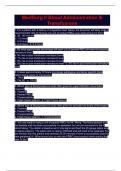
1. For a patient with a history of congestive heart failure, the physician will likely order a recommended rate of infusing one unit of packed RBCs over what amount of time? a. 30 - 60 minutes b. 1-2 hours c. 2-3 hours d. 3-4 hours - d. 3-4 hours 2. By what approximate percentage will each unit of packed RBC will raise the baseline hematocrit level? a. No rise in post transfusion hematocrit level b. 1% rise in post transfusion hematocrit level c. 3% rise in post transfusion hematocrit level d. 6% rise in post transfusion hematocrit level - c. 3% rise in post transfusion hematocrit level 3. It takes approximately 72 hours to process autologous and donor specific blood before being ready for transfusion. a. TRUE b. FALSE - a. TRUE 4. Which type of blood product is most often given for urgent Warfarin (Coumadin) reversal? a. Platelets b. Packed RBCs c. Cryoprecipitate d. Fresh frozen plasma - d. Fresh frozen plasma 5. Which type of blood product is most often given for severely low levels of fibrinogen? a. Platelets b. Packed RBCs c. Cryoprecipitate d. Fresh frozen plasma - c. Cryoprecipitate 6. You are ready to hang a unit of packed RBCs for Mr. Wong. The blood product is at the bedside and has been successfully co-assessed, but not yet connected to the Y blood tubing. You obtain a baseline set of vital signs and flush the 20 gauge saline lock to assure patency. The saline lock is clearly infiltrated and will need to be restarted. You are familiar with this patient and estimate 20-30 minutes of time to successfully start the new peripheral IV. What should you do with the PRBC blood product while starting the new IV line? a. Temporarily store the unit of PRBCs in the medication refrigerator b. Leave the unit of PRBCs at the bedside and hope for quick IV start c. Return the unit of PRBCs back to the designated blood bank designated refrigerator d. To avoid delay, piggy back the blood tubing into the continuous heparin drip IV line and administer the unit of PRBCs through this shared line - c. Return the unit of PRBCs back to the designated blood bank designated refrigerator 7. The standard IV blood administration tubing can be safely used to administer up to 3 units of packed RBCs? a. True b. FALSE - b. FALSE 8. The only approved IV solution to be used to prime blood tubing is: a. 0.45 % Normal Saline b. D5 ½ Normal Saline c. 0.9% Normal Saline d. Lactated Ringers - c. 0.9% Normal Saline 9. Which blood type is considered to be the Universal Donor? a. Type O + b. Type O - c. Type AB + d. Type AB - - b. Type O - 10. Which blood type is considered to be the Universal Recipient? a. Type O + b. Type O - c. Type AB + d. Type AB - - c. Type AB + 11. Which of the following is NOT an essential component of the safe co-assessment between the wrist-band and blood bag label prior to blood product administration: a. Last blood glucose level b. ABO/RH type compatibility c. Blood bank armband number d. Medical record number or other designated number - a. Last blood glucose level 12. Which of the following is a potential acute transfusion reaction? a. HIV infection b. CMV infection c. Hepatitis infection d. Hemolytic reaction - d. Hemolytic reaction
Document information
- Uploaded on
- June 28, 2023
- Number of pages
- 7
- Written in
- 2022/2023
- Type
- Exam (elaborations)
- Contains
- Questions & answers


