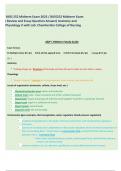
A And P 1 Midterm Study Guide 2023.
Exam Format: 35 Multiple choice @ 3 pts 4 Pick all that apply @ 5 pts 15 Fill in the blank @ 2 pts 1 essay @ 15 pts Ch. 1 Anatomy • “Cutting things up.” Structure of the body and how the parts relate to each other in space. Physiology • “Study of nature.” Function of a living organism, how it works, and maintains life. Levels of organization (molecular, cellular, tissue level, etc.) • Chemical/molecular level: atoms and molecules • Cellular level: cells – basic structural unit of life, smallest living unit • Tissue level: tissues are groups of cells that work together to perform a particular function • Organ Level: organ is a collection of tissues • Organ System: several levels • Organism level: the human body Homeostasis (give examples, thermoregulation, water regulation, blood pressure regulation) • Condition of equilibrium in the body’s internal environment, and maintained by regulatory processes. • Survival of our body cells is dependent on the precise regulation of the chemical composition of their surrounding fluid o Fluid known as extracellular fluid, and fluid that fills narrow spaces between cells is interstitial fluid. ▪ Other types are blood plasma, lymph, cerebrospinal fluid, synovial fluid, aqueous humor, and vitreous body. • Internal conditions are in a dynamic equilibrium; set point (like thermostat in house) lOMoARcPSD| • Essential for maintenance of life; death and disease • Homeostatic control loop; receptor, control center and effector • Negative Feedback: works to oppose change, brings condition back to a set point. i.e. – blood pressure • Positive Feedback: works to enhance change, brings condition further away from a set point. i.e. – childbirth, blood clotting. Things that don’t occur a lot. • Water Regulation: kidneys and water balance concentration of mineral ions in the blood, get rid of waste products, especially nitrogen-containing compound called urea. o Can also be excreted, and removes heat from the body when a person sweats, helping regulate body temp
Document information
- Uploaded on
- June 28, 2023
- Number of pages
- 20
- Written in
- 2022/2023
- Type
- Exam (elaborations)
- Contains
- Questions & answers