
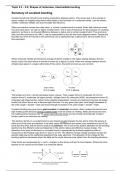
Topic 2.3 – 2.4: Shapes of molecules, Intermediate bonding
Summary of covalent bonding
Covalent bonds are formed by the sharing of electrons between atoms. This occurs due to the overlap of
atomic orbitals on neighbouring atoms which leads to the formation of a molecular orbital. Just like atomic
orbitals, molecular orbitals can accommodate two electrons.
When one electron comes from each atom, a ‘normal’ covalent bond is formed. When both electrons come
from the same atom, we call it a dative covalent bond. This is only of relevance for the purposes of ‘counting
electrons’ as there is no physical difference between a dative and a normal covalent bond. Thus ammonia
+
(NH3) and the ammonium ion (NH4 ) may be represented by the dot-and-cross diagrams below. Despite the
fact that one of the N-H bonds in the ammonium ion is represented as a dative bond, all four bonds are in
fact equivalent.
+
H H
H N H N H
dative
H H bond
When molecular orbitals are formed by overlap of atomic orbitals in the region directly between the two
atomic nuclei, the bond which is formed is known as a sigma (σ) bond. When the overlap between atomic
orbitals takes place in a region either side of this vector, the bond is known as a pi (π) bond.
C2pz C2pz
Osp3
H1s
Sigma orbital Pi orbital
e.g. O-H in water C=C in ethene
The tendency to form π-bonds decreases down a group. Thus oxygen forms O2 molecules (O=O), but
sulphur forms S8 molecules (all sigma bonds); nitrogen forms N2 molecules (N≡N), but phosphorus forms P4
molecules (all single bonds); carbon forms graphite (delocalised π-bonds) and diamond structure (all single
bonds) but silicon forms only a diamond-type structure. For any given atom pair, bond length decreases in
the order single > double > triple and bond strength increases in the order single < double < triple.
Covalent bonding may give rise to giant covalent or molecular structures. Giant covalent structures have
high melting points because strong covalent bonds must be broken on melting. Molecular structures have
low melting points because only the weak intermolecular forces (not the strong intramolecular covalent
bonds) need to be overcome on melting.
The electron density in a covalent bond is only shared equally between the two atoms when the groups at
either end of the bond are identical. In all other cases the electrons are drawn more towards one end of the
bond than the other and the bond is said to be polarised. This is due to the relative attraction for the bonding
electrons by the different nuclei and depends on the atomic radius and effective nuclear charge. The
attraction of an atom for electrons in a covalent bond is represented by its electronegativity which is
measured on the Pauling scale from 0.7 (Cs) to 4.0 (F). The effective nuclear charge increases across the
periodic table due to the ineffective shielding of the outer electrons. The attraction of this charge for the
bonding electrons decreases down the table as the nuclei become more distant from the bonding electrons.
Polar bonds are represented by δ+ and δ- charges on the atoms and lead to bond dipoles. Where the bond
dipoles do not cancel out this leads to a molecular dipole.
δ−
molecular dipole O bond dipole
δ− δ+ δ−
O C O
δ+ δ+
H H
molecular dipole = vector sum of bond (and lone pair) dipoles
N.B. lp dipoles ignored here
Summary of covalent bonding
Covalent bonds are formed by the sharing of electrons between atoms. This occurs due to the overlap of
atomic orbitals on neighbouring atoms which leads to the formation of a molecular orbital. Just like atomic
orbitals, molecular orbitals can accommodate two electrons.
When one electron comes from each atom, a ‘normal’ covalent bond is formed. When both electrons come
from the same atom, we call it a dative covalent bond. This is only of relevance for the purposes of ‘counting
electrons’ as there is no physical difference between a dative and a normal covalent bond. Thus ammonia
+
(NH3) and the ammonium ion (NH4 ) may be represented by the dot-and-cross diagrams below. Despite the
fact that one of the N-H bonds in the ammonium ion is represented as a dative bond, all four bonds are in
fact equivalent.
+
H H
H N H N H
dative
H H bond
When molecular orbitals are formed by overlap of atomic orbitals in the region directly between the two
atomic nuclei, the bond which is formed is known as a sigma (σ) bond. When the overlap between atomic
orbitals takes place in a region either side of this vector, the bond is known as a pi (π) bond.
C2pz C2pz
Osp3
H1s
Sigma orbital Pi orbital
e.g. O-H in water C=C in ethene
The tendency to form π-bonds decreases down a group. Thus oxygen forms O2 molecules (O=O), but
sulphur forms S8 molecules (all sigma bonds); nitrogen forms N2 molecules (N≡N), but phosphorus forms P4
molecules (all single bonds); carbon forms graphite (delocalised π-bonds) and diamond structure (all single
bonds) but silicon forms only a diamond-type structure. For any given atom pair, bond length decreases in
the order single > double > triple and bond strength increases in the order single < double < triple.
Covalent bonding may give rise to giant covalent or molecular structures. Giant covalent structures have
high melting points because strong covalent bonds must be broken on melting. Molecular structures have
low melting points because only the weak intermolecular forces (not the strong intramolecular covalent
bonds) need to be overcome on melting.
The electron density in a covalent bond is only shared equally between the two atoms when the groups at
either end of the bond are identical. In all other cases the electrons are drawn more towards one end of the
bond than the other and the bond is said to be polarised. This is due to the relative attraction for the bonding
electrons by the different nuclei and depends on the atomic radius and effective nuclear charge. The
attraction of an atom for electrons in a covalent bond is represented by its electronegativity which is
measured on the Pauling scale from 0.7 (Cs) to 4.0 (F). The effective nuclear charge increases across the
periodic table due to the ineffective shielding of the outer electrons. The attraction of this charge for the
bonding electrons decreases down the table as the nuclei become more distant from the bonding electrons.
Polar bonds are represented by δ+ and δ- charges on the atoms and lead to bond dipoles. Where the bond
dipoles do not cancel out this leads to a molecular dipole.
δ−
molecular dipole O bond dipole
δ− δ+ δ−
O C O
δ+ δ+
H H
molecular dipole = vector sum of bond (and lone pair) dipoles
N.B. lp dipoles ignored here


