Nucleotides
What are Nucleotides?
Biological molecules that participate in nearly all chemical processes
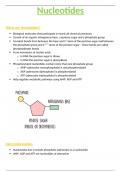
Consist of an organic nitrogenous base, a pentose sugar and a phosphate group
Covalent bonds form between the base and C1 atom of the pentose sugar and between
the phosphate group and C3 or 5 atom of the pentose sugar – these bonds are called
phosphodiester bonds
Form monomers of nucleic acids
o In RNA the pentose sugar is ribose
o In DNA the pentose sugar is deoxyribose
Phosphorylated nucleotides contain more than one phosphate group
o AMP (adenosine monophosphate) is not phosphorylated
o ADP (adenosine diphosphate) is phosphorylated
o ATP (adenosine triphosphate) is phosphorylated
Help regulate metabolic pathways using AMP, ADP and ATP
Extra Information
Nucleosides don’t contain phosphate (adenosine is a nucleoside)
AMP, ADP and ATP are nucleotides of adenosine
What are Nucleotides?
Biological molecules that participate in nearly all chemical processes
Consist of an organic nitrogenous base, a pentose sugar and a phosphate group
Covalent bonds form between the base and C1 atom of the pentose sugar and between
the phosphate group and C3 or 5 atom of the pentose sugar – these bonds are called
phosphodiester bonds
Form monomers of nucleic acids
o In RNA the pentose sugar is ribose
o In DNA the pentose sugar is deoxyribose
Phosphorylated nucleotides contain more than one phosphate group
o AMP (adenosine monophosphate) is not phosphorylated
o ADP (adenosine diphosphate) is phosphorylated
o ATP (adenosine triphosphate) is phosphorylated
Help regulate metabolic pathways using AMP, ADP and ATP
Extra Information
Nucleosides don’t contain phosphate (adenosine is a nucleoside)
AMP, ADP and ATP are nucleotides of adenosine