

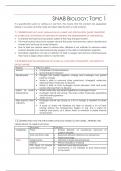
SNAB BIOLOGY: TOPIC 1
If a specification point or writing is in red font, this means that this content has appeared
before in an exam and the notes are taken directly from a mark scheme.
1.1 UNDERSTAND WHY MANY ANIMALS HAVE A HEART AND CIRCULATION ( MASS TRANSPORT
TO OVERCOME LIMITATIONS OF DIFFUSION IN MEETING THE REQUIREMENTS OF ORGANISMS ).
• In animals the heart and circulatory system is the mass transport system.
• The heart pumps blood and oxygen around the body and removes carbon dioxide and
wastes from the body by mass transport.
• Due to their low surface area to volume ratio, diffusion is not sufficient to remove waste
(carbon dioxide and urea) and provide oxygen to the cells in multicellular organism.
• Unicellular organisms can rely on diffusion to take in oxygen and remove waste because
they have a large surface area to volume ratio.
1.2 UNDERSTAND THE IMPORTANCE OF WATER AS A SOLVENT IN TRANSPORT , INCLUDING ITS
DIPOLE NATURE .
Nature Why it is useful
Solvent • Component of blood plasma
• Good transport medium
Dipole/polar • Oxygen has partial negative charge and hydrogen has partial
positive charge.
• Water is able to surround other polar/ionic (charged) molecules
allowing these molecules to dissolve
• Water is able to form hydrogen bonds between itself and polar
solutes allowing them to dissolve
Liquid at room • Water molecules are joined together by hydrogen bonds
temperature • Hydrogen bonds are strong, this stops water molecules separating
and becoming gaseous
• Ability to flow
High specific heat • Hydrogen bonds are strong so a lot of energy is needed to break
capacity them
• A body of water will therefore be able to absorb a lot of heat
energy before the temperature begins to rise, this is useful for
animals and plants, as it allows them to maintain a stable internal
environment
1.3 UNDERSTAND HOW THE STRUCTURES OF BLOOD VESSELS (CAPILLARIES, ARTERIES AND
VEINS) RELATE TO THEIR FUNCTIONS .
Structure Function
Capillaries Pores • Enable diffusion of substances (removal of
carbon dioxide)
One cell thick walls • Reduced diffusion distance for substances
• Faster exchange
Veins Large lumen • Maintain a lower blood pressure
Valves • Prevent backflow of blood
Thin layer of muscle • Maintain lower blood pressure
and elastic tissue • Contraction is not needed to push blood back
to the heart
, Smooth endothelium • Reduce resistance to blood flow
Arteries Thick layer of • Strength to withstand high blood pressure
(e.g. aorta, collagen
carries Thick muscular wall • Muscles contract to allow the constriction of the
oxygenated lumen
blood from • Maintain a high blood pressure (from the left
the heart ventricle)
under high Many elastic fibres • Allow the lumen to stretch and recoil (able to
pressure) return to its original size)
• Maintain a high blood pressure
Narrow lumen • Maintain a high blood pressure
Smooth endothelium • Reduce resistance to blood flow
1.4 I) KNOW THE CARDIAC CYCLE ( ATRIAL SYSTOLE, VENTRICULAR SYSTOLE AND CARDIAC
DIASTOLE) AND RELATE THE STRUCTURE AND OPERATION OF THE MAMMALIAN HEART ,
INCLUDING THE MAJOR BLOOD VESSELS , TO ITS FUNCTION . II) K NOW HOW THE RELATIONSHIP
BETWEEN HEART STRUCTURE AND FUNCTION CAN BE INVESTIGATED PRACTICALLY .
Atrial Systole • Blood under low pressure enters the left and right atria
• The atria fill, increasing blood pressure
• When the pressure in the atria is greater than the pressure in the ventricles
the AV vales open and the atria walls contract
• Blood pushed/forced into the ventricles
Ventricular • Pressure increases in ventricles as they begin to fill with blood
Systole • When ventricular pressure is greater than atrial pressure the AV valves
close and the SL valves open
• Muscles in ventricular walls contract and blood if forced into the arteries
Cardiac • Atria and ventricles relax
Diastole • Elastic recoil of walls lowers blood pressure
• Blood is under higher pressure in the aorta and pulmonary artery so SL
valves close and AV valves open
If a specification point or writing is in red font, this means that this content has appeared
before in an exam and the notes are taken directly from a mark scheme.
1.1 UNDERSTAND WHY MANY ANIMALS HAVE A HEART AND CIRCULATION ( MASS TRANSPORT
TO OVERCOME LIMITATIONS OF DIFFUSION IN MEETING THE REQUIREMENTS OF ORGANISMS ).
• In animals the heart and circulatory system is the mass transport system.
• The heart pumps blood and oxygen around the body and removes carbon dioxide and
wastes from the body by mass transport.
• Due to their low surface area to volume ratio, diffusion is not sufficient to remove waste
(carbon dioxide and urea) and provide oxygen to the cells in multicellular organism.
• Unicellular organisms can rely on diffusion to take in oxygen and remove waste because
they have a large surface area to volume ratio.
1.2 UNDERSTAND THE IMPORTANCE OF WATER AS A SOLVENT IN TRANSPORT , INCLUDING ITS
DIPOLE NATURE .
Nature Why it is useful
Solvent • Component of blood plasma
• Good transport medium
Dipole/polar • Oxygen has partial negative charge and hydrogen has partial
positive charge.
• Water is able to surround other polar/ionic (charged) molecules
allowing these molecules to dissolve
• Water is able to form hydrogen bonds between itself and polar
solutes allowing them to dissolve
Liquid at room • Water molecules are joined together by hydrogen bonds
temperature • Hydrogen bonds are strong, this stops water molecules separating
and becoming gaseous
• Ability to flow
High specific heat • Hydrogen bonds are strong so a lot of energy is needed to break
capacity them
• A body of water will therefore be able to absorb a lot of heat
energy before the temperature begins to rise, this is useful for
animals and plants, as it allows them to maintain a stable internal
environment
1.3 UNDERSTAND HOW THE STRUCTURES OF BLOOD VESSELS (CAPILLARIES, ARTERIES AND
VEINS) RELATE TO THEIR FUNCTIONS .
Structure Function
Capillaries Pores • Enable diffusion of substances (removal of
carbon dioxide)
One cell thick walls • Reduced diffusion distance for substances
• Faster exchange
Veins Large lumen • Maintain a lower blood pressure
Valves • Prevent backflow of blood
Thin layer of muscle • Maintain lower blood pressure
and elastic tissue • Contraction is not needed to push blood back
to the heart
, Smooth endothelium • Reduce resistance to blood flow
Arteries Thick layer of • Strength to withstand high blood pressure
(e.g. aorta, collagen
carries Thick muscular wall • Muscles contract to allow the constriction of the
oxygenated lumen
blood from • Maintain a high blood pressure (from the left
the heart ventricle)
under high Many elastic fibres • Allow the lumen to stretch and recoil (able to
pressure) return to its original size)
• Maintain a high blood pressure
Narrow lumen • Maintain a high blood pressure
Smooth endothelium • Reduce resistance to blood flow
1.4 I) KNOW THE CARDIAC CYCLE ( ATRIAL SYSTOLE, VENTRICULAR SYSTOLE AND CARDIAC
DIASTOLE) AND RELATE THE STRUCTURE AND OPERATION OF THE MAMMALIAN HEART ,
INCLUDING THE MAJOR BLOOD VESSELS , TO ITS FUNCTION . II) K NOW HOW THE RELATIONSHIP
BETWEEN HEART STRUCTURE AND FUNCTION CAN BE INVESTIGATED PRACTICALLY .
Atrial Systole • Blood under low pressure enters the left and right atria
• The atria fill, increasing blood pressure
• When the pressure in the atria is greater than the pressure in the ventricles
the AV vales open and the atria walls contract
• Blood pushed/forced into the ventricles
Ventricular • Pressure increases in ventricles as they begin to fill with blood
Systole • When ventricular pressure is greater than atrial pressure the AV valves
close and the SL valves open
• Muscles in ventricular walls contract and blood if forced into the arteries
Cardiac • Atria and ventricles relax
Diastole • Elastic recoil of walls lowers blood pressure
• Blood is under higher pressure in the aorta and pulmonary artery so SL
valves close and AV valves open


