The Supreme Court
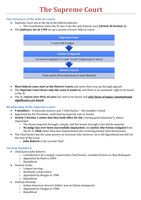
The structure of the federal courts:
• Supreme Court sits at the tip of the federal judiciary
o The Constitution states the SC was to be the only federal court (Article III Section 1)
• The Judiciary Act of 1789 set up a system of lower federal courts
Supreme Court
1 court with 9 judges
Courts of Appeals
13 courts of appeals (1 in each 'circuit' (region) plus 2 more)
District Courts
Trial courts, 94 in total (one in each district)
• Most federal cases start at the District Courts and move their way up through appeals
• The Supreme Court hears only the cases it wants to, and there is no automatic right to be heard
in the SC
• The SC rejects over 96% of cases the seek to be heard, and only those of major constitutional
significance are heard
Membership of the Supreme Court:
• 9 members – 8 Associate Justices and 1 Chief Justice – this number is fixed
• Appointed by the President, confirmed by majority vote in Senate
• Article 3 Section 1 states that they hold office for life (‘during good behaviour’), unless
impeached
o The House impeach through a simple, and the Senate through a two-thirds majority
o No judge has ever been successfully impeached, but Justice Abe Fortas resigned from
the SC in 1968 rather than face impeachment (for receiving money from businesses)
• The Chief Justice has the same powers as everyone else, however, he is the figurehead and will set
the tone of the Court
o John Roberts is the current Chief
Current members:
• Chief Justice John Roberts:
o Considered to be a largely conservative Chief Justice, considered more so than Rehnquist
o Appointed by Bush in 2005
o Republican
• Antonin Scalia:
o Longest serving
o Relatively conservative
o Appointed by Reagan in 1986
o Republican
• Anthony Kennedy:
o Italian-American descent (father was an Italian immigrant)
o Appointed by Reagan in 1988
o Republican