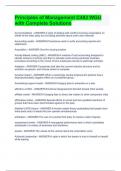
Principles of Management C483 WGU with Complete Solutions
Accommodation - ANSWER-A style of dealing with conflict involving cooperation on behalf of the other party but not being assertive about one's own interests Accounting audits - ANSWER-Procedures used to verify accounting reports and statements Acquisition - ANSWER-One firm buying another Activity-Based costing (ABC) - ANSWER-A method of cost accounting designed to identify streams of activity and then to allocate costs across particular business processes according to the mount of time employees devote to particular activities Adapters - ANSWER-Companies that take the current industry structure and its evolution as givens, and choose where to compete. Adverse impact - ANSWER-When a seemingly neutral employment practice has a disproportionately negative effect on a protected group. Advertising support model - ANSWER-Charging fees to advertise on a site. affective conflict - ANSWER-Emotional disagreement directed toward other people affiliate model - ANSWER-Charging fees to direct site visitors to other companies' sites affirmative action - ANSWER-Special efforts to recruit and hire qualified members of groups that have been discriminated against in the past. Alderfer's ERG theory - ANSWER-A human needs theory postulating that people have three basic sets of needs that can operate simultaneously arbitration - ANSWER-The use of a neutral third party to resolve a labor dispute. assessment center - ANSWER-A managerial performance test in which candidates participate in a variety of exercises and situations. assets - ANSWER-The values of the various items the corporation owns. Authentic leadership - ANSWER-A style in which the leader is true to himself or herself while leading autocratic leadership - ANSWER-A form of leadership in which the leader makes decisions on his or her own and then announces those decisions to the group autonomous work groups - ANSWER-Groups that control decisions about and excution of a complete range of tasks avoidance - ANSWER-A reaction to conflict that involves ignoring the problem by doing nothing at all, or deemphasizing the disagreement. balance sheet - ANSWER-A report that shows the financial picture of a company at a given time and itemizes assets, liabilities, and stockholders' equity balanced scorecard - ANSWER-Control system combining four sets of performance measures: financial, customer, business process, and learning and growth barriers to entry - ANSWER-Conditions that prevent new companies from entering an industry behavioral approach - ANSWER-a leadership perspective that attempts to identify what good leaders do-that is, what behaviors they exhibit benchmarking - ANSWER-The process of comparing an organization's practices and technologies with those of other companies. Bootlegging - ANSWER-Informal work on projects, other than those officially assigned, of employees' own choosing and initiative boundaryless organization - ANSWER-organization in which there are no barriers to information flow. bounded rationality - ANSWER-`A less-than-perfect form of rationality in which decisions makers cannot be perfectly rational because decisions are complex and complete information is unavailable or cannot be fully processed. Brainstorming - ANSWER-A process in which group members generate as many ideas about a problem as they can; criticism is withheld until all ideas have been proposed. bridge leaders - ANSWER-A leader who bridges conflicting value systems or different cultures. broker - ANSWER-A person who assembles and coordinates participants in a network budgeting - ANSWER-The process of investigating what is being done and comparing the results with the corresponding budget data to verify accomplishments or remedy differences; also called budgetary controlling buffering - ANSWER-Creating supplies of excess resources in case of unpredictable needs bureaucratic control - ANSWER-The use of rules, regulations, and authority to guide performance business incubators - ANSWER-Protected environments for new, small businesses business plan - ANSWER-A formal planning step that focuses on the entire venture and describes all the elements involved in starting it. Business strategy - ANSWER-The major actions by which a business competes in a particular industry or market Cafeteria benefit program - ANSWER-An employee benefit program in which employees choose from a menu of options to create a benefit package tailored to their needs. Caux Principles - ANSWER-Ethical principles established by international executives based in Caux, Switzerland, in collaboration with business leaders from Japan, Europe, and the United States. centralized organization - ANSWER-An organization in which high-level executives make most decisions and pass them down to lower levels for implementation. certainty - ANSWER-The state that exists when decision makers have accurate and comprehensive information. charismatic leader - ANSWER-A person who is dominant, self-confident, convinced of the moral righteousness of his or her beliefs, and able to arouse a sense of excitement and adventure in followers. chief information officer (CIO) - ANSWER-Executive in charge of information technology strategy and development. clan control - ANSWER-Control based on the norms, values, shared goals, and trust among group members. coaching - ANSWER-Dialogue with a goal of helping another be more effective and achieve his or her full potential on the job. coalitional model - ANSWER-Model of organizational decision making in which groups with differing preferences use power and negotiation to influence decisions. cognitive conflict - ANSWER-Issue-based differences in perspectives or judgments. cohesiveness - ANSWER-The degree to which a group is attractive to its members, members are motivated to remain in the group, and members influence one another. collaboration - ANSWER-A style of dealing with conflict emphasizing both cooperation and assertiveness to maximize both parties' satisfaction. comparable worth - ANSWER-Principle of equal pay for different jobs of equal worth. competing - ANSWER-A style of dealing with conflict involving strong focus on one's own goals and little or no concern for the other person's goals. competitive environment - ANSWER-The immediate environment surrounding a firm; includes suppliers, customers, rivals, and the like. competitive intelligence - ANSWER-Information that helps managers determine how to compete better. compliance-based ethics programs - ANSWER-Company mechanisms typically designed by corporate counsel to prevent, detect, and punish legal violations. computer-integrated manufacturing (CIM) - ANSWER-The use of computer-aided design and computer-aided manufacturing to sequence and optimize a number of production processes. concentration - ANSWER-A strategy employed for an organization that operates a single business and competes in a single industry. concentric diversification - ANSWER-A strategy used to add new businesses that produce related products or are involved in related markets and activities. conceptual and decision skills - ANSWER-Skills pertaining to the ability to identify and resolve problems for the benefit of the organization and its members. concurrent control - ANSWER-The control process used while plans are being carried out, including directing, monitoring, and fine-tuning activities as they are performed. conflict - ANSWER-Opposing pressures from different sources, occurring on the level of psychological conflict or of conflict between individuals or groups. conglomerate diversification - ANSWER-A strategy used to add new businesses that produce unrelated products or are involved in unrelated markets and activities. contingency plans - ANSWER-Alternative courses of action that can be implemented based on how the future unfolds. continuous process - ANSWER-A process that is highly automated and has a continuous production flow. control - ANSWER-Any process that directs the activities of individuals toward the achievement of organizational goals. controlling - ANSWER-The management function of monitoring performance and making needed changes. cooperative strategies - ANSWER-Strategies used by two or more organizations working together to manage the external environment. coordination by mutual adjustment - ANSWER-Units interact with one another to make accommodations to achieve flexible coordination. coordination by plan - ANSWER-Interdependent units are required to meet deadlines and objectives that contribute to a common goal. core competence - ANSWER-A unique skill and/or knowledge an organization possesses that give it an edge over competitors. corporate governance - ANSWER-The role of a corporation's executive staff and board of directors in ensuring that the firm's activities meet the goals of the firm's stakeholders. corporate social responsibility (CSR) - ANSWER-Obligation toward society assumed by business. corporate strategy - ANSWER-The set of businesses, markets, or industries in which an organization competes and the distribution of resources among those entities. cost competitiveness - ANSWER-Keeping costs low to achieve profits and be able to offer prices that are attractive to consumers. current ratio - ANSWER-A liquidity ratio that indicates the extent to which short-term assets can decline and still be adequate to pay short-term liabilities. customer relationship management (CRM) - ANSWER-A multifaceted process focusing on creating two-way exchanges with customers to foster intimate knowledge of their needs, wants, and buying patterns. custom-made solutions - ANSWER-New, creative solutions designed specifically for the problem. debt-equity ratio - ANSWER-A leverage ratio that indicates the company's ability to meet its long-term financial obligations.
Document information
- Uploaded on
- June 20, 2023
- Number of pages
- 23
- Written in
- 2022/2023
- Type
- Exam (elaborations)
- Contains
- Questions & answers