Research methods 1.1
Study online at https://quizlet.com/_beyzgj
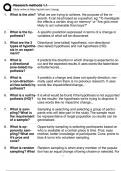
1. What is the aim? What we are trying to achieve, the purpose of the re-
search. It can be phrased as a question. eg: "To investigate
the effects a certain drug on memory" or "Are girls more
likely to act vulnerable than boys?"
2. What is the hy- A specific prediction expressed in terms of a change in
pothesis? variables of what will be discovered.
3. What are the 3 Directional (one-tailed) hypothesis, non-directional
types of hypothe- (two-tailed) hypothesis and null hypothesis (HO).
sis in an experi-
ment?
4. What is It predicts the direction in which change is expected to oc-
a directional cur and the expected results. It uses words like faster/slow-
(one-tailed) hy- er/better/worse...
pothesis?
5. What is It predicts a change and does not specify direction, nor-
a non-direction- mally used when there is no previous research. It uses
al (two-tailed) hy- words like impact/effect/change...
pothesis?
6. What is a null hy- It is what would be found if the hypothesis is not supported
pothesis (HO)? by the results- the hypothesis we're trying to disprove. It
uses words like no impact/no change...
7. What is sam- Sampling is searching and selecting a group of partici-
pling? What is pants who will take part in the study. The sample must
the requirement be representative of target population so results can be
of a sample? generalised.
8. What is op- Opportunity sampling is selecting participants based on
porunity sam- who is available at a certain place & time. Pros: easy
pling? What are method, better knowledge of participants. Cons: prone to
it's pros and bias & turns into volunteer sampling.
cons?
9. What is random Random sampling is when every member of the popula-
sampling? What tion has an equal change of being chosen or selected. For
1/3
, Research methods 1.1
Study online at https://quizlet.com/_beyzgj
are it's pros and example pulling names out of a hat. Pros: unbiased selec-
cons? tion so the sample is representative & can be generalised.
Cons: impractical
10. What is volunteer Volunteer sampling is individuals who have chosen to take
sampling? What place in the study, for example by responding to an Ad.
are it's pros and Pros: easy method. Cons: prone to bias, volunteers certain
cons? "type" of person, demand characteristics if ppts know the
aim of the experiment- "screw you" or perfect ppt. Counter
arguement: can be solved through deception & debriefing
them at the end.
11. What is system- Systematic sampling is when participants are chosen in
atic sampling? a systematic (orderly) way from the target population, for
What are it's example using nth term. Pros: better version of random
pros? sampling, unbiased selection, representative so can be
generalised.
12. What is stratified Stratified sampling is when participants are selected to
sampling? What represent a target population (in proportions or %) by di-
are it's pros and viding the population into stratas (subgroups). Pros: sam-
cons? ple can be generalised to target population. Cons: time
consuming & need for other sampling method first.
13. What is snowball Snowball sampling is when the researcher collects data
sampling? What on the few members of a target population they can locate
are it's pros and and then ask those individuals to provide info needed to
cons? locate other members of that population. Pros: sometimes
the only method to find a difficult population. Cons: costly,
time consuming, unrepresentative sample, only used for
exploration.
14. What are vari- Variables are a thing whose values can change. An exper-
ables? What are iment tries to find out whether the independent variable
the 5 types? has an effect on the dependent variable. There are also
control variables, extraneous variables and confounding
variables.
15. An independent variable is a variable of the experiment
that is manipulated by the researcher (what you change).
2/3
Study online at https://quizlet.com/_beyzgj
1. What is the aim? What we are trying to achieve, the purpose of the re-
search. It can be phrased as a question. eg: "To investigate
the effects a certain drug on memory" or "Are girls more
likely to act vulnerable than boys?"
2. What is the hy- A specific prediction expressed in terms of a change in
pothesis? variables of what will be discovered.
3. What are the 3 Directional (one-tailed) hypothesis, non-directional
types of hypothe- (two-tailed) hypothesis and null hypothesis (HO).
sis in an experi-
ment?
4. What is It predicts the direction in which change is expected to oc-
a directional cur and the expected results. It uses words like faster/slow-
(one-tailed) hy- er/better/worse...
pothesis?
5. What is It predicts a change and does not specify direction, nor-
a non-direction- mally used when there is no previous research. It uses
al (two-tailed) hy- words like impact/effect/change...
pothesis?
6. What is a null hy- It is what would be found if the hypothesis is not supported
pothesis (HO)? by the results- the hypothesis we're trying to disprove. It
uses words like no impact/no change...
7. What is sam- Sampling is searching and selecting a group of partici-
pling? What is pants who will take part in the study. The sample must
the requirement be representative of target population so results can be
of a sample? generalised.
8. What is op- Opportunity sampling is selecting participants based on
porunity sam- who is available at a certain place & time. Pros: easy
pling? What are method, better knowledge of participants. Cons: prone to
it's pros and bias & turns into volunteer sampling.
cons?
9. What is random Random sampling is when every member of the popula-
sampling? What tion has an equal change of being chosen or selected. For
1/3
, Research methods 1.1
Study online at https://quizlet.com/_beyzgj
are it's pros and example pulling names out of a hat. Pros: unbiased selec-
cons? tion so the sample is representative & can be generalised.
Cons: impractical
10. What is volunteer Volunteer sampling is individuals who have chosen to take
sampling? What place in the study, for example by responding to an Ad.
are it's pros and Pros: easy method. Cons: prone to bias, volunteers certain
cons? "type" of person, demand characteristics if ppts know the
aim of the experiment- "screw you" or perfect ppt. Counter
arguement: can be solved through deception & debriefing
them at the end.
11. What is system- Systematic sampling is when participants are chosen in
atic sampling? a systematic (orderly) way from the target population, for
What are it's example using nth term. Pros: better version of random
pros? sampling, unbiased selection, representative so can be
generalised.
12. What is stratified Stratified sampling is when participants are selected to
sampling? What represent a target population (in proportions or %) by di-
are it's pros and viding the population into stratas (subgroups). Pros: sam-
cons? ple can be generalised to target population. Cons: time
consuming & need for other sampling method first.
13. What is snowball Snowball sampling is when the researcher collects data
sampling? What on the few members of a target population they can locate
are it's pros and and then ask those individuals to provide info needed to
cons? locate other members of that population. Pros: sometimes
the only method to find a difficult population. Cons: costly,
time consuming, unrepresentative sample, only used for
exploration.
14. What are vari- Variables are a thing whose values can change. An exper-
ables? What are iment tries to find out whether the independent variable
the 5 types? has an effect on the dependent variable. There are also
control variables, extraneous variables and confounding
variables.
15. An independent variable is a variable of the experiment
that is manipulated by the researcher (what you change).
2/3