

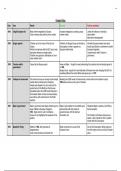
Foreign Policy
Date Area Details Success Failures/ problems
1986 Single European Act Britain further integrated into Europe. Increased integration by creating a large Limited the influence of individual
Closer monetary and political unions created. internal market. nation-states.
Made them interdependent.
1988 Bruges speech - Thatcher set out her vision of the future of In Britain, the Bruges Group was formed by Infuriated European leaders and raised
Europe. Eurosceptics in order to oppose any doubts about Britain’s commitment to further
Wanted to emphasise that the EEC was a trade European federal state. European integration.
association between sovereign states. Caused tension within Thatcher’s
Thatcher was opposed to federalism and ‘ever government.
closer political union’.
1986 Tensions within Caused by the Bruges speech. Howe and Major - thought she was backtracking from positions she had already agreed to
government in 1985.
Bruges Group - argued that it was federalists in Brussels who were changing the EEC into
something different from which Britain had signed up to in 1973.
1989 Collapse of communism The Soviet economy was in deep trouble despite Realising the USSR would not intervene led a domino effect across Eastern Europe.
market reforms introduced by Gorbachev. 1989 became known as the ‘year of miracles’.
People were allowed to be more critical of the
government and the Brezhnev Doctrine was
repudiated (where the USSR would intervene in
the domestic affairs of other communist states),
even after an anti-communist won the Polish
elections.
1993 Major’s government Major’s government was deeply divided upon the Major’s style enabled him to establish good Weakened Major’s position as the PMs as
issue of Britain’s European integration. personal links with other heads of the Eurosceptics.
1993 - Major won the vote of confidence, government esp. Kohl the German
however it only highlighted the weakness of his Chancellor. edu Part of Major’s off-camera interview was
position. leaked - made it harder for him to position
himself with the Eurosceptics.
1993 Maastricht Treaty Ratified in 1993, after great deal of Britain continued to be a part of the Due to the Eurosceptics, Britain opted-out
disagreements. European Union. from the single currency and Social Chapter
It set up new structures to deal with the plans.
Date Area Details Success Failures/ problems
1986 Single European Act Britain further integrated into Europe. Increased integration by creating a large Limited the influence of individual
Closer monetary and political unions created. internal market. nation-states.
Made them interdependent.
1988 Bruges speech - Thatcher set out her vision of the future of In Britain, the Bruges Group was formed by Infuriated European leaders and raised
Europe. Eurosceptics in order to oppose any doubts about Britain’s commitment to further
Wanted to emphasise that the EEC was a trade European federal state. European integration.
association between sovereign states. Caused tension within Thatcher’s
Thatcher was opposed to federalism and ‘ever government.
closer political union’.
1986 Tensions within Caused by the Bruges speech. Howe and Major - thought she was backtracking from positions she had already agreed to
government in 1985.
Bruges Group - argued that it was federalists in Brussels who were changing the EEC into
something different from which Britain had signed up to in 1973.
1989 Collapse of communism The Soviet economy was in deep trouble despite Realising the USSR would not intervene led a domino effect across Eastern Europe.
market reforms introduced by Gorbachev. 1989 became known as the ‘year of miracles’.
People were allowed to be more critical of the
government and the Brezhnev Doctrine was
repudiated (where the USSR would intervene in
the domestic affairs of other communist states),
even after an anti-communist won the Polish
elections.
1993 Major’s government Major’s government was deeply divided upon the Major’s style enabled him to establish good Weakened Major’s position as the PMs as
issue of Britain’s European integration. personal links with other heads of the Eurosceptics.
1993 - Major won the vote of confidence, government esp. Kohl the German
however it only highlighted the weakness of his Chancellor. edu Part of Major’s off-camera interview was
position. leaked - made it harder for him to position
himself with the Eurosceptics.
1993 Maastricht Treaty Ratified in 1993, after great deal of Britain continued to be a part of the Due to the Eurosceptics, Britain opted-out
disagreements. European Union. from the single currency and Social Chapter
It set up new structures to deal with the plans.


