
Sociology final straighterline|2023 LATEST UPDATE|GUARANTEED SUCCESS
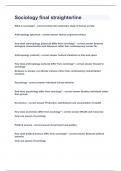
What is sociology? the systematic study of human society Anthropology (physical) Human origins/revolution How does anthropology (physical) differ from sociology? Stresses biological characteristics and behaviors rather than contemporary human life. Anthropology (cultural) Cultural variations in time and space How does anthropology (cultural) differ from sociology? Closest to sociology Stresses on simple, non-literate cultures rather than contemporary industrialized societies. Psychology Individual human behavior How does psychology differ from sociology? Studies individuals rather than groups. Economics Production, distributions and consumption of wealth. How does economics differ from sociology? Wealth and resources Only one aspect of sociology Political science Government and politics How does political science differ from sociology? Stresses political behavior Only one aspect of sociology Functionalist Perspective Society as a system A system is to survive where certain essential tasks are performed. If it fails to maintain it will perish Benefits society in general by rewarding occupations vital to group welfare. The system of rewards motivates competent people to sacrifice to become doctors and lawyers. Conflict Perspective Society as a whole Studying institutions and structural arrangements Viewed as the exploitation of many while rewarding the few. Stratification is an unjust system inflicted on society by those with power and wealth in order to maintain their own interests. Interactionist Perspective Human beings have the ability to communicate with one another by means of symbols. We act toward people, objects, and events on the basis of the meanings we impart to them. Interactionists are interested in the importance of social call with regard to an individuals lifestyle. For example: Not only do the very rich buy more than they need or can use (conspicuous consumption and conspicuous leisure) but many also try to keep the lower class "away" or "under control" Feminist Perspective Effects of inequities based on gender Critical Theory Mass culture cannot be a true reflection of peoples beliefs, tastes and values. Sociological Imagination The ability to see the link between society and self Socialization Lifelong process of social interaction by which people acquire knowledge, values, attitudes, and behaviors Agents of Scoialization a. Family b. Peers c. School d. Workspace e. Mass media Culture Learned patterns of thinking, feeling and acting transmitted from one generation to the next. Totality of a complex whole. Society Fairly large number of people who life independently in the same region. Participate in common culture. Norms - Formal Behaviors that have been written down and specify strict punishments for violators. Norms - Informal Standards of behavior generally understood but not written down. Ex: manners, way people dress, greetings. Norms - Folkways Norms governing everyday behavior Ex: Customary rules of conduct but not vital to welfare of society. Culture in flux Culture is not static, but always in flux, always changing. Cultures 1. Values, beliefs, and attitudes (non-material culture) 2. Objects and power relations (material culture)*Should include 3. Ways of seeing the world (paradigms) 4. Relating to others (interaction styles)
Document information
- Uploaded on
- June 19, 2023
- Number of pages
- 10
- Written in
- 2022/2023
- Type
- Exam (elaborations)
- Contains
- Questions & answers


