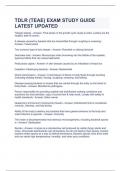
TDLR (TEAE) EXAM STUDY GUIDE LATEST UPDATED
Telegen lashes - Answer- Final phase in the growth cycle ready to shed. Lashes are the longest, dark & course. A disease caused by bacteria that are transmitted through coughing or sneezing - Answer- Tuberculosis Two common type of eye shapes - Answer- Rounded or oblong (almond) Demodex mite - Answer- Microscopic mites burrowing into the follicle of the eyelash, eyebrow follicle that can cause blepharitis. Pediculosis capitis - Answer- A skin disease caused by an infestation of head lice Capable of destroying bacteria - Answer- Bactericidal Direct transmission - Answer- Transmission of blood or body fluids through touching (including shaking hands), kissing, coughing, sneezing, and talking. Disease-causing bacteria or viruses that are carried through the body on the blood or body fluids - Answer- Bloodborne pathogens Person responsible for providing suitable wet disinfectant soaking containers and autoclave dry heat sterilizer, copy of current law & rules book, comply with safety & health standards - Answer- Salon owner Quaternary Ammonium Compounds (Quats) - Answer- Disinfectant that is considered nontoxic, odorless, and fast-acting Ability of the body to destroy any bacteria that have gained entrance to the body and resist infection in general. - Answer- Immunity The mode of decontamination that destroys microorganisms, including bacterial spores is - Answer- Sterilization Spores - Answer- A spore is a reproductive cell produced by certain fungi, plants and moss. Chemicals disinfectants can kill bacteria, but do not destroy their spores. Certain bacteria make spores as a way to defend themselves. Bacteria spores have thick walls and can resist high temperatures, humidity, and other poor conditions. A process called sterilization destroys spores and bacteria. It is done at high temperatures and under high pressures. In health-care settings, sterilization is usually done using a device called an autoclave. Sanitize - Answer- The process of destroying or reducing organisms on a clean surface to a safe level. 70% - Answer- Isopropyl Alcohol Concentration Carbolic acid; caustic poison; in 5% dilute solution is used to sanitize metallic implements - Answer- Phenol 90% - Answer- Ethyl Alcohol Concentration Eyelash growth cycle - Answer- a cycle lasting approx. 30 to 60 days that includes growth cycles (anagen-growth, catagen-rest, telogen-shedding) State Regulatory Agencies - Answer- A set guidelines for the manufacturing, sale and use of equipment and chemical, and along safety standards in the workplace. Evaluation - Answer- A comprehensive process of obtaining and interpreting the data necessary to understand the individual, system, or situation Slender, hair-like extensions that permit locomotion in certain bacteria ; whip-like motion moves them in liquid - Answer- Cilia Causing disease; harmful - Answer- Pathogenic disease Asymptomatic - Answer- Showing no symptoms or signs of infection Infectious - Answer- Communicable by infection, as from one person to another or from one part of the body to another Short, rod-shaped bacteria; the most common bacteria; produce diseases such as tetanus (lockjaw), typhoid fever, tuberculosis, and diphtheria - Answer- Bacilli (Singular; Bacillus) Also known as barber's itch; a superficial fungal infection that commonly affects the skin. It is primarily to the beared areas of thee face and neck or around the scalp - Answer- Tine barbae
Written for
- Institution
- TDLR
- Course
- TDLR
Document information
- Uploaded on
- June 13, 2023
- Number of pages
- 6
- Written in
- 2022/2023
- Type
- Exam (elaborations)
- Contains
- Questions & answers
Subjects
-
tdlr teae exam study guide latest updated

Also available in package deal