
Science Final Study Guide
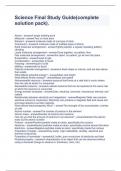
Science Final Study GuideAtoms - answerA single building bock Molecule - answerTwo or more atom Element - answerA molecule made of one type of atom Compound - answerA molecule made of multiple types of atoms Solid molecular arrangement - answerTightly packed, a regular repeating pattern, vibrating Liquid molecular arrangement - answerClose together, no pattern, flow Gas molecular arrangement - answerFar apart, no pattern, go all over the place Evaporation - answerLiquid to gas Condensation - answerGas to liquid Freezing - answerliquid to solid Melting - answersolid to liquid Plasma molecular arrangement - answerno fixed shape or volume, and are less dense than solids What effects potential energy? - answerMass and height What effects kinetic energy? - answerMass and speed Nonrenewable resource - answera resource that forms at a rate that is much slower than the rate at which it is consumed Renewable resource - answerA natural resource that can be replaced at the same rate at which the resource is consumed Energy transfer examples - answerSolar, electrical, chemical, mechanical, thermal, and radiant Relationship between electricity and magnetism - answerMagnetic fields can produce electrical current in conductors. Electricity can produce a magnetic field and cause iron and steel objects to act like magnets. What affects electromagnetic force? - answerThe strength of the source/batter, number of coils Atomic number - answerThe number of protons in the element Atomic mass - answerNumber of protons and neutrons How do you find the amount of neutrons in an element? - answerSubtract the atomic mass by the atomic number Protons - answerPositive particle inside an atom, specifically the nucleus Neutrons - answerNeutral particles inside an atom, specifically revolve around the atom Electrons - answerNegative particles inside an atom, specifically inside the nucleus Properties of metals - answerShiny luster, high malleability, ductility, electrical and thermal conductivity. Properties of nonmetals - answerdull, brittle, poor conductors of electricity and heat Physical property - answerA characteristic of an object that can be observed without using a chemical change to observe it. (hardness, color, etc)
Document information
- Uploaded on
- June 9, 2023
- Number of pages
- 2
- Written in
- 2022/2023
- Type
- Exam (elaborations)
- Contains
- Questions & answers


