
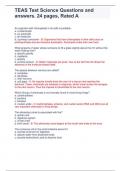
TEAS Test Science Questions and answers. 24 pages, Rated A
An organism with chloroplasts in its cells is probably. a. a heterotroph b. an autotroph c. an herbivore d. a primary consumer - B: Organisms that have chloroplasts in their cells carry on photosynthesis and are therefore autotrophs. Autotrophs make their own food. What property of water allows someone to fill a glass slightly above the rim without the water flowing over? a. specific gravity b. capillarity c. opacity d. surface tension - D: Water molecules are polar. Due to the fact that O2 draws the electrons in the molecule toward itself. The spaces between neurons are called? a. synapses b. dendrites c. inter-neurons d. cell gaps - A: An impulse travels down the axon of a neuron and reaches the terminus. There, chemicals are released in response, which travel across the synapse to the next neuron. Thus the impulse is transmitted to the next neuron. Which Group of chemicals is not normally found in most living things? a. carbohydrates b. proteins c. silicates d. nucleic acids - C: Carbohydrates, proteins, and nucleic acids (RNA and DNA) are all very important chemicals in living things. The alimentary canal is associated with the? a. spinal cord b. digestive system c. urinary tract d. birth canal - B: The alimentary canal begins at the mouth and ends at the anus. The numerous villi in the small intestine serve to? a. secrete enzymes for digestion b. absorb water from dissolved foods c. secrete hydrochloric acid to dissolve food d. provide greater surface for absorption - D: The villi are tiny projections in the small intestine that increase the total surface area of the intestine for absorption of digested nutrients. As light passes obliquely from air to water, it is bent. This bending is called? a. diffraction b. reflection c. refraction d. dispersion - C: Refraction is the bending of light as it passes obliquely from one medium to another. Which of the following organelles is not involved in protein synthesis? a. ribsome b. mitochondrion c. rough endoplasmic reticulum
Document information
- Uploaded on
- June 5, 2023
- Number of pages
- 24
- Written in
- 2022/2023
- Type
- Exam (elaborations)
- Contains
- Questions & answers


