

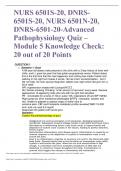
NURS 6501S-20, DNRS-6501S-20, NURS 6501N-20, DNRS-6501-20-Advanced Pathophysiology Quiz – Module 5 Knowledge Check
NURS 6501S-20, DNRS-6501S-20, NURS 6501N-20, DNRS-6501-20-Advanced Pathophysiology Quiz – Module 5 Knowledge Check A 68-year-old obese male presents to the clinic with a 3-day history of fever with chills, and Lt. great toe pain that has gotten progressively worse. Patient states this is the first time that this has happened, and nothing has made it better and walking on his right foot makes it worse. He has tried acetaminophen, but it did not help. He took several ibuprofen tablets last night which did give him a bit of relief. HPI: hypertension treated with Lisinopril/HCTZ . SH: Denies smoking. Drinking: “a fair amount of red wine” every week. General appearance: Ill appearing male who sits with his right foot elevated. PE: remarkable for a temp of 100.2, pulse 106, respirations 20 and BP 158/92. Right great toe (first metatarsal phalangeal [MTP]) noticeably swollen and red. Unable to palpate to assess range of motion due to extreme pain. CBC and Complete metabolic profile revealed WBC 15,000 mm3 and uric acid 9.0 mg/dl. Diagnoses the patient with acute gout. Question: Explain why a patient with gout is more likely to develop renal calculi. • Uric acid is mostly excreted through the kidneys. The overproduction and under secretion of uric acid can reduce the effectiveness of kidneys excreting uric acid. This results in the formation of monosodium urate crystals in the renal tubules, which then results in nephropathy. Renal stones are significantly more prevalent in individuals with gout compared to the general population. These renal calculi are often made of monosodium urate. Individuals with gout are significantly more prone to the formation of renal calculi. The kidneys are affected by gout because the kidneys are responsible for excreting most of the uric acid in the body. An excess amount of uric acid decreases the effectiveness of the kidney’s ability
Document information
- Uploaded on
- May 27, 2023
- Number of pages
- 7
- Written in
- 2022/2023
- Type
- Exam (elaborations)
- Contains
- Questions & answers


