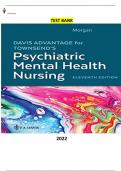
Test bank for Davis Advantage for Townsend's Psychiatric Mental
Test bank for Davis Advantage for Townsend's Psychiatric Mental Health Nursing 11E Karyn I. Morgan. ALL Chapters(1-37) Included |464| Pages - Questions & Answers
Pass Basic Psychiatric Mental Health Nursing in First Attempt Guaranteed!Get 100% Latest Exam Questions, Accurate & Verified Answers to Pass the Actual Exam! Instant Download!
Davis Advantage for Townsend's Psychiatric Mental Health Nursing 11E Karyn I. Morgan
ISBN-10 7
ISBN-13 978-0
I. BASIC CONCEPTS IN PSYCHIATRIC-MENTAL HEALTH NURSING
1. The Concept of Stress Adaptation
2. Mental Health and Mental Illness: Historical and Theoretical Concepts
II. FOUNDATIONS FOR PSYCHIATRIC-MENTAL HEALTH NURSING
3. Concepts of Psychobiology
4. Psychopharmacology
5. Ethical and Legal Issues
III. THERAPEUTIC APPROACHES IN PSYCHIATRIC NURSING CARE
6. Relationship Development
7. Therapeutic Communication
8. The Nursing Process in Psychiatric-Mental Health Nursing
9. Therapeutic Groups
10. Intervention with Families
11. Milieu Therapy—The Therapeutic Community
12. Crisis Intervention
13. Assertiveness Training
14. Promoting Self Esteem
15. Anger and Aggression Management
16. Suicide Prevention
17. Behavior Therapy
18. Cognitive Behavioral Therapy
19. Electroconvulsive Therapy
20. The Recovery Model
IV. NURSING CARE OF PATIENTS WITH ALTERATIONS IN PSYCHOSOCIAL ADAPTATION
21. Caring for Patients with Mental Illness and Substance Use Disorders in General Practice Settings
22. Neurocognitive Disorders
23. Substance-Related and Addictive Disorders
24. Schizophrenia Spectrum and Other Psychotic Disorders
25. Depressive Disorders
26. Bipolar and Related Disorders
27. Anxiety, Obsessive-Compulsive, and Related Disorders
28. Trauma and Stressor-Related Disorders
29. Somatic Symptom and Dissociative Disorders
30. Eating Disorders
31. Personality Disorders
V. PSYCHIATRIC/MENTAL HEALTH NURSING OF SPECIAL POPULATIONS
32. Children and Adolescents
33. The Aging Individual
34. Survivors of Abuse or Neglect
35. Community Mental Health Nursing
36. The Bereaved Individual
37. Military Families
1. For several years, the nurse has been working in the subspecialty field of forensic nursing. In this field, the nurse would recognize which current trend?
1. A decrease in violent crime has resulted in a decreased need for forensic nurses.
2. Medical examiners prefer to employ forensic nurses because of their medical background.
3. With increasing numbers of violent crimes, forensic nurses are in greater demand than ever.
4. Forensic nurses comprise a dwindling subspecialty.
ANS: 3
Chapter: Chapter 43, Forensic Nursing
Objective: Discuss historical perspectives of forensic nursing. Page: 966
Heading: Historical Perspectives Integrated Processes: Nursing Process Nursing Process: Assessment
Client Need: Psychosocial Integrity Cognitive Level: Knowledge [Remembering] Concept: Health Care System
Difficulty: Moderate
Feedback
1. This is incorrect. Violent crime has increased, and there is an increased need for
forensic nurses.
2. This is incorrect. Forensic nurses are nurses with additional training in forensics;
they did not go to medical school.
3. This is correct. Violent crime has reached epidemic proportions in the United States and is identified as a major public health problem, increasing the demand for
forensic nurses.
4. This is incorrect. Forensic nurses are in high demand but do not comprise a
dwindling subspecialty.
CON: Health Care System
2. An 18-year-old client is admitted to an emergency department, reporting that she has just been raped. On physical assessment, the nurse notices no trauma to the genital region. Which information would influence the forensic nurse’s evaluation of this assessment data?
1. Between 60% and 80% of confirmed rapes show genital trauma.
2. Inconsistency of verbalized reports and collected evidence suggests deception.
3. Lack of genital trauma indicates consensual sex.
4. Between 40% and 60% of sexual assaults leave no visible injuries.
ANS: 4
Chapter: Chapter 43, Forensic Nursing
Objective: Apply the nursing process within the role of clinical forensic nursing in trauma care.
Page: 968
Heading: Application of the Nursing Process in Clinical Forensic Nursing Trauma Care
Planning/Implementation Treatment and Documentation of Injuries Integrated Processes: Nursing Process
Nursing Process: Assessment
Client Need: Physiological Integrity: Physiological Adaptation Cognitive Level: Knowledge [Remembering]
Concept: Violence Difficulty: Moderate
Feedback
1. This is incorrect. Between 40% and 60% of sexual assaults showed no visible
injuries.
2. This is incorrect. Inconsistency between verbalized reports and collected evidence
does not necessarily mean an assault did not occur.
3. This is incorrect. The absence of physical trauma (either genital or nongenital) does
not necessarily mean that no force was used or that consent was given.
4. This is correct. There may be no visible injuries in 40% to 60% of sexual assaults.
CON: Violence
3. A forensic nurse collects a semen sample from a rape victim. Which nursing action maintains the proper chain of evidence?
1. A collected sample is labeled, sealed, and kept in a locked refrigerator until given to police.
2. The sample is locked in a special container and given to the pathologist.
3. The sample is placed in the medication room refrigerator prior to police collection.
4. The sample is sealed and immediately given to police to avoid contamination.
ANS: 1
Chapter: Chapter 43, Forensic Nursing
Objective: Apply the nursing process within the role of clinical forensic nursing in trauma care.
Page: 968
Heading: Application of the Nursing Process in Clinical Forensic Nursing Trauma Care
Planning/Implementation Preservation of Evidence Maintaining the Proper Chain of Custody
Integrated Processes: Nursing Process Nursing Process: Implementation
Client Need: Safe and Effective Care Environment: Management of Care Cognitive Level: Application [Applying]
Concept: Legal Difficulty: Moderate
Feedback
1. This is correct. Collected evidence must be kept separate from other items, labeled, and sealed to prevent tampering or loss. Sealed and correctly labeled evidence kits or bags may be stored in a secure location until they are transferred to law enforcement officials. The best place to store evidence is in a locked drop box and locked
refrigerator, located in a limited-access room that requires key entry.
2. This is incorrect. The sample is given to the police, not the pathologist.
3. This is incorrect. The medication room is not the room with the most limited access.
4. This is incorrect. Sealed and correctly labeled evidence kits or bags may be stored in a secure location until they are transferred to law enforcement officials.
CON: Legal
4. A rape victim is concerned about becoming pregnant. Which intervention by the nurse practitioner is appropriate?
1. Refer the client to an abortion clinic.
2. Refer the client to a spiritual counselor.
3. Offer the client Plan B One-Step.
4. Instruct the client to douche daily for 1 week.
ANS: 3
Chapter: Chapter 43, Forensic Nursing
Objective: Apply the nursing process within the role of clinical forensic nursing in trauma care.
Page: 968
Heading: Application of the Nursing Process in Clinical Forensic Nursing Trauma Care
Planning/Implementation Pregnancy Risk Evaluation and Prevention Integrated Processes: Nursing Process
Nursing Process: Implementation
Client Need: Physiological Integrity: Pharmacological and Parenteral Therapies Cognitive Level: Analysis [Analyzing]
Concept: Violence Difficulty: Moderate
Feedback
1. This is incorrect. There is no indication the client is pregnant; in addition, it is not
appropriate for the provider to refer the client to an abortion clinic.
2. This is incorrect. If the client is concerned about becoming pregnant, referring her to
a spiritual advisor does not address her concerns.
3. This is correct. Sexual assault victims should receive information related to risks and interventions for prevention of conception resulting from the assault. Prophylactic measures, like the use of Plan B One-Step, are 97% to 98% effective in preventing pregnancy if given in the first 24 hours after a sexual attack. Evaluation of pregnancy risk is based on the client’s ability to relay accurate information about the
occurrence of her last menses so that an estimate can be made of time of ovulation.
4. This is incorrect. Douching daily for 1 week will not prevent pregnancy.
CON: Violence
5. Which statement indicates the most important reason for the forensic nurse to maintain a proper chain of evidence?
1. Maintaining a proper chain of evidence will exonerate the perpetrator.
2. Maintaining a proper chain of evidence will assist in gathering enough data for conviction.
3. All evidence, if properly maintained, will convict the assailant.
4. Crime data maintained with a proper chain of evidence can be used in a court of law.
ANS: 4
Chapter: Chapter 43, Forensic Nursing
Objective: Apply the nursing process within the role of clinical forensic nursing in trauma care.
Page: 969
Heading: Application of the Nursing Process in Clinical Forensic Nursing Trauma Care
Planning/Implementation Preservation of Evidence Maintaining the Proper Chain of Custody
Integrated Processes: Nursing Process Nursing Process: Assessment
Client Need: Safe and Effective Care Environment: Management of Care Cognitive Level: Analysis [Analyzing]
Concept: Legal Difficulty: Moderate
Feedback
1. This is incorrect. Maintaining a chain of evidence does not exonerate the perpetrator.
2. This is incorrect. Maintaining a proper chain of evidence does not assist in gathering
enough data for conviction.
3. This is incorrect. Just because evidence is properly maintained does not necessarily
mean the assailant will be convicted.
4. This is correct. Chain of custody is a legal process referring to the paper trail that assures the integrity and security of the evidence. Unless the proper chain of custody has been maintained, evidence cannot be used successfully in a court of law to
convict an assailant.
CON: Legal
6. A sexual assault nurse examiner is called to examine a college student who reports a date rape. Which nursing intervention is the priority?
1. Take samples of potential evidence.
2. Ensure medical stabilization.
3. Take pictures of the wounds.
4. Call law enforcement officials to report the rape.
ANS: 2
Chapter: Chapter 43, Forensic Nursing
Objective: Apply the nursing process within the role of clinical forensic nursing in trauma care.
Page: 969
Heading: Application of the Nursing Process in Clinical Forensic Trauma Care Planning/Implementation Preservation of Evidence
Integrated Processes: Nursing Process Nursing Process: Implementation
Client Need: Physiological Integrity: Physiological Adaptation Cognitive Level: Application [Applying]
Concept: Violence Difficulty: Moderate
Feedback
1. This is incorrect. Although taking samples of evidence is a nursing intervention that
will be implemented, ensuring medical stabilization is the priority.
2. This is correct. When a sexual assault victim is admitted to the emergency
department, medical stabilization is the priority intervention.
3. This is incorrect. Taking pictures of the wounds will occur after the client is
medically stable.
4. This is incorrect. The nurse will call law enforcement to report the rape after the
client is medically stable.
CON: Violence
7. Which inmate statement to the prison nurse describes the circumstances that have the strongest correlation with recidivism among the prison population?
1. “I was high on crack when I blew him away.”
2. “I never finished high school.”
3. “My upbringing was nonexistent.”
4. “I’m a product of the foster care system.”
ANS: 1
Chapter: Chapter 43, Forensic Nursing
Objective: Apply the nursing process within the role of clinical forensic nursing in trauma care.
Page: 973
Heading: Assessing Mental Health Needs of the Incarcerated Integrated Processes: Nursing Process
Nursing Process: Assessment
Client Need: Physiological Integrity Cognitive Level: Evaluation [Evaluating] Concept: Addictions and Behaviors Difficulty: Moderate
Feedback
1. This is correct. Substance abuse has been shown to have a strong correlation with recidivism among the prison population. Many individuals report that they were
under the influence of illegal substances at the time of their criminal actions.
2. This is incorrect. Not completing high school does not mean a client will reoffend.
3. This is incorrect. A poor upbringing is not an indicator of recidivism.
4. This is incorrect. Being a product of the foster care system does not necessarily
mean the client will reoffend.
CON: Addiction and Behaviors
8. A prison nurse is reviewing an inmate’s health record. Which documentation indicates a dual diagnosis?
1. Bipolar II disorder and antisocial personality disorder
2. Schizophrenia and alcohol dependence
3. Attention deficit disorder and conduct disorder
4. Cocaine addiction and marijuana abuse
ANS: 2
Chapter: Chapter 43, Forensic Nursing
Objective: Apply the nursing process within the role of clinical forensic nursing in trauma care.
Page: 973
Heading: Assessing Mental Health Needs of the Incarcerated Integrated Processes: Communication and Documentation Client Need: Psychosocial Integrity
Cognitive Level: Analysis [Analyzing] Concept: Addiction and Behaviors Difficulty: Moderate
Feedback
1. This is incorrect. Bipolar disorder and antisocial personality disorder are not dual
diagnoses.
2. This is correct. An individual who has a coexisting substance disorder and a mental illness meets the criteria for dual diagnoses. Dual diagnoses are commonly identified in incarcerated individuals. Psychiatric diagnoses commonly identified in incarcerated individuals include schizophrenia, bipolar disorder, major depression,
substance use disorders, and personality disorders.
3. This is incorrect. Attention deficit disorder and conduct disorder are not dual diagnoses.
4. This is incorrect. Cocaine addiction and marijuana abuse are not dual diagnoses.
CON: Addiction and Behaviors
9. In a gang war, a gang member is wounded. The police have confiscated a switchblade. When assessing the victim, which type of injury would the forensic nurse expect to assess?
1. Dicing injuries
2. Sharp-force injuries
3. Patterned injuries
4. Defense wound injuries
ANS: 2
Chapter: Chapter 43, Forensic Nursing
Objective: Apply the nursing process within the role of clinical forensic nursing in trauma care.
Page: 969
Heading: Application of the Nursing Process in Clinical Forensic Nursing in the Investigation of Trauma Care Investigation of Wound Characteristics Integrated Processes: Assessment
Nursing Process: Assessment
Client Need: Physiological Integrity: Physiological Adaptation Cognitive Level: Analysis [Analyzing]
Concept: Violence Difficulty: Moderate
Feedback
1. This is incorrect. Dicing injuries are multiple, minute cuts and abrasions caused by
contact with shattered glass that often occur in motor vehicle accidents.
2. This is correct. Sharp-force injuries include stab wounds and other wounds resulting
from penetration with a sharp object, such as a switchblade.
3. This is incorrect. Patterned injuries are specific injuries that reflect the pattern of the
weapon used to inflict the injury.
4. This is incorrect. Defense wounds are injuries that reflect the victim’s attempt to defend themself from attack.
CON: Violence
10. A forensic nurse identified patterned injuries on a 3-year-old child. Which assessment data led to this conclusion?
1. Multiple minute cuts and abrasions
2. Generalized bruising of the buttock
3. Circular burn marks the size of a lit cigarette
4. Stab wounds resulting from sharp-object penetration
ANS: 3
Chapter: Chapter 43, Forensic Nursing
Objective: Apply the nursing process within the role of clinical forensic nursing in trauma care.
Page: 969
Heading: Application of the Nursing Process in Clinical Forensic Nursing in the Investigation of Trauma Care Investigation of Wound Characteristics Integrated Processes: Nursing Process
Nursing Process: Assessment
Client Need: Physiological Integrity: Physiological Adaptation Cognitive Level: Analysis [Analyzing]
Concept: Violence Difficulty: Moderate
Content preview
Prof.Exams
TEST BANK
2022
,Prof.Exams
COMPLETE
Elaborated Test Bank
for
Davis Advantage
for
Townsend's Psychiatric Mental
Health Nursing
11Ed.
by
Karyn I. Morgan.
2022
,Prof.Exams
Davis Advantage for Townsend's Psychiatric Mental
Health Nursing 11Ed.by Karyn I. Morgan.
ISBN-10 1719648247
ISBN-13 978-1719648240
Test bank for Davis Advantage for Townsend's Psychiatric Mental Health Nursing 11Ed.by Karyn I.
Morgan.
ISBN-10 1719648247
ISBN-13 978-1719648240
THIS IS NOT THE ACTUAL BOOK. YOU ARE BUYING it is the Official Test Bank
in e-version INSTANT DOWNLOAD
>The test bank is what most professors use as a template when making exams for their students, which means
there’s a very high chance that you will see the exact questions in the tests!
>The file is either in.pdf, excel, or zipped in the package and can easily be read on PCs and Macs.
>Delivery is INSTANT. You can download the files IMMEDIATELY once payment is done.
If you have any questions, please feel free to contact us. Our response is the fastest. All questions will alwaysbe
answered in 6 hours, most of the time within 30mins.
We also faced similar difficulties when we were students, and we understand how you feel. But now, with the
Official Test Bank, you will be able to
* Anticipate the type of the questions that will appear in your exam.
* Know the correct answers to those questions.
* Reduce the hassle and stress of your student life.
* Improve your studying and get a better grade!
* Get prepared for examination questions.
* Save you time and help you understand the material.
, Prof.Exams
TABLE OF CONTENTS
I. BASIC CONCEPTS IN PSYCHIATRIC-MENTAL HEALTH NURSING
1. The Concept of Stress Adaptation
2. Mental Health and Mental Illness: Historical and Theoretical Concepts
II. FOUNDATIONS FOR PSYCHIATRIC-MENTAL HEALTH NURSING
3. Concepts of Psychobiology
4. Psychopharmacology
5. Ethical and Legal Issues
III. THERAPEUTIC APPROACHES IN PSYCHIATRIC NURSING CARE
6. Relationship Development
7. Therapeutic Communication
8. The Nursing Process in Psychiatric-Mental Health Nursing
9. Therapeutic Groups
10. Intervention with Families
11. Milieu Therapy—The Therapeutic Community
12. Crisis Intervention
13. Assertiveness Training
14. Promoting Self Esteem
15. Anger and Aggression Management
16. Suicide Prevention
17. Behavior Therapy
18. Cognitive Behavioral Therapy
19. Electroconvulsive Therapy
20. The Recovery Model
IV. NURSING CARE OF PATIENTS WITH ALTERATIONS IN PSYCHOSOCIAL ADAPTATION