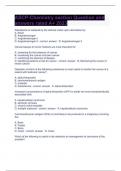
ASCP-Chemistry section Question and answers rated A+ 2023
ASCP-Chemistry section Question and answers rated A+ 2023Aldosterone is released by the adrenal cortex upon stimulation by: A. Renin B. Angiotensinogen C. Angiotenisinogen I D. Angiotensinogen II D. Angiotensinogen II Clinical Assays for tumor markers are most important for: A. screening for the presence of cancer B. monitoring the course of known cancer C. confirming the absence of disease D. identifying patients at risk for cancer B. Monitoring the course of known cancer Detection of which of the following substances is most useful to monitor the course of a patient with testicular cancer? A. alpha-fetoprotein B. carcinoembryonic antigen C. prolactin D. testosterone A. alpha-fetoprotein Increased concentrations of alpha-fetoprotein (AFP) in adults are most characteristically associated with: A. hepatocellular carcinoma B. alcoholic cirrhosis C. chronic active hepatitis D. multiple myeloma A. hepatocellular carcinoma Carcinoembryonic antigen (CEA) is most likely to be produced in a maignancy involving the: A. Brain B. Testes C. Bone D. Colon D. Colon Which of the following is useful in the detection an management of carcinoma of the prostate? A. total prostate-specific antigen B. prostatic acid phosphatase C. human chorionic gonadotropin D. alpha-fetoprotein A. total prostate-specific antigen Which of the following statements most correctly describes the utility of clinical laboratory assays for tumor markers? A. tumor markers are useful to screen asymptomatic patients for tumors B. tumor markers are highly specific C. tumor markers indicate the likelihood of an individual developing a tumor D. tumors are useful in tracking the efficacy of treatment D. tumors are useful in tracking the efficacy of treatment Cancer antigen 125 (CA 125) is a tumor marker associated with: A. breast carcinoma B. colon cancer C. lung cancer D. ovarian and endometrial carcinoma D. ovarian and endometrial carcinoma In addition to carcinoma of the prostate, elevated prostate-specific antigen (PSA) can occur due to: A. aspirin therapy B. exogenous steroid use C. benign prostatic hyperplasia D. statin therapy (cholesterol lowering drugs) C. benign prostatic hyperplasia
Document information
- Uploaded on
- May 19, 2023
- Number of pages
- 13
- Written in
- 2022/2023
- Type
- Exam (elaborations)
- Contains
- Questions & answers