
Nursing 6001 Study Guide
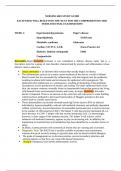
hypertension/hypotension Paget’s disease Hyperlipidemia SOAP note Metabolic syndrome Glaucoma Cardiac: CP, PVC, A-Fib Nurse Practice Act Diabetes: Diabetic retinopathy EMR Conjunctivitis Dermatitis-Atopic dermatitis (eczema) is not considered a distinct disease entity but is a descriptive term for a group of skin disorders characterized by pruritus and inflammation whose distinct cause is unknown. Atopic dermatitis is an inherited skin reaction that usually begins in infancy. The inflammatory process in eczema causes erythema of the skin as a result of dilated blood vessels that are surrounded by inflammatory cells that migrate into the epidermis, resulting in edema both inside and in between the epidermal cells (spongiosis). The epidermal cells malfunction as a consequence, resulting in thickening of the epidermis (acanthosis), excess production of keratin, and scaling. The outer epidermal layer of the skin, the stratum corneum, normally forms an impermeable barrier that protects the living cells beneath from environmental irritants and toxins. In atopic dermatitis, this outer barrier is impaired. There is an increase in the water loss and a decrease in water binding, which has been attributed to decreased functionality of filaggrin proteins in the skin, which leads to a brittle outer barrier. These abnormalities can include elevated serum IgE levels (seen in 85% of affected individuals), hypereosinophilia, reduced cell-mediated immunity and antibody-dependent cellular cytotoxicity, slowed chemotaxis of neutrophils and monocytes, a relative increase in the number of CD4-positive (CD4+) Th2 helper T cells that secrete interleukin (IL)-4, and a decrease in CD4+ T helper cells that secrete interleukin-2 (IL-2). Interestingly, however, in later stages of the immune reaction, Th1 helper T-cell activity, which enhances cell-mediated immunity, appears to play an increasing role. In addition, the impairment of essential fatty acid metabolism has been identified as a causative factor of atopy. In adults, eczema presents with symmetrical lesions that are crusting and excoriated
Document information
- Uploaded on
- May 17, 2023
- Number of pages
- 14
- Written in
- 2022/2023
- Type
- Class notes
- Professor(s)
- Prof
- Contains
- All classes


