

3A Turfgrass Pest Management Study Guide.
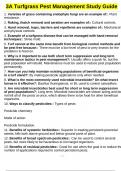
3A Turfgrass Pest Management Study Guide. 1. Varieties of grass containing endophyte fungi are an example of:: Plant resistance. 2. Raking, thatch removal and aeration are examples of:: Cultural controls. 3. Hand removal, traps, barriers and repellents are examples of:: Mechanical and physical controls. 4. Example of a turfgrass disease that can be managed with hand removal techniques:: Slime mold. 5. Turf cannot at the same time benefit from biological control methods and be pest free because:: There must be a low level of pest or prey insects for the predators to feed on. 6. Why is it important to use both short term suppression and long term maintenance tactics in pest management?: Usually offers a quick fix, but the pest population will rebuild. Maintenance must be used to reduce pest populations permanently. 7. How can you help maintain existing populations of beneficial organisms in a turf stand?: By making pesticide applications only when needed. 8. What is the most commonly used microbial insecticide? On what insect larvae is it effective?: Bacillus thuringiensis, or Bt, used to control caterpillars. 9. Are microbial insecticides best used for short or long term suppression of pest populations?: Long term. Microbial insecticides are slower acting and do not kill all of the pests at once, which allows there to be food for other beneficial organisms. 10. Ways to classify pesticides:: Types of pests Pesticide chemistry Mode of action Pesticide formulation. 11. Benefits of systemic herbicides:: Superior in treating persistent perennial weeds, kills both above ground and below ground parts of plant. 12. Benefits of broad spectrum pesticides:: Can be used to control several pests, but more likely to be hazardous to non target organisms. 13. Benefits of residual pesticides:: Good for use when the goal is to reduce the number of applications required to control persistent pests. 1 / 16 3A Turfgrass Pest Management Study Guide 14. Benefits of contact herbicides:: Does not kill the underground parts of plant. 15. Basic principles of managing pests in turfgrass:: Produce healthy plants that can reduce or better tolerate pest attack Identify what is damaging the turf Expect some pests and tolerate some damage Using pesticides as a last resort. 16. Steps of IPM for turfgrass:: Detect pest Identify pest Determine the amount of damage and whether it is below or above the tolerance thresholds Select and use a management tactic Evaluate the effectiveness of the strategy and keep records. 17. Methods for monitoring and detecting turfgrass pests:: Visually Coffee can flush White paper test Root sampling Disclosing solution 18. Explain why keeping track of degree day accumulations is more useful for monitoring pest activity than going by calendar dates:: Insects, diseases and weeds develop based on heat units. The accumulation of heat units varies from year to year. 19. Explain how knowing the species or variety of turfgrass in a stand can help in pest diagnosis:: Certain diseases and insect pests will affect certain species of turfgrass and will not affect others. 20. Economic injury threshold:: The density of pests at which the cost to manage the pest is equal to the losses caused by that pest. 2 / 16 3A Turfgrass Pest Management Study Guide 21. Action threshold:: The pest density at which action must be taken to prevent the pest from reaching the economic injury level. 22. Factors influencing the economic injury level:: The client's tolerance for damage. The health of the turf stand. Level of maintenance required for the turf stand to fulfill its purpose. 23. Factors of pest management tactics will be limited by:: Budget. Availability of equipment. Availability of personnel. Time available for pest management activities. Availability of products that control the problem. Public or client acceptance of the management methods. 24. Questions that should be answered by the evaluation of your IPM program:: Did it work? Did it hurt anything else? Was it practical and cost-effective? 25. Reasons turf needs water:: To move nutrients to and inside the plants. As part of the process of converting light and carbon dioxide to sugar. To cool the plants in the heat of the day. 26. What are the categories of grass species in the US and Canada? Which category in most commonly used in MI?: Cool season, transition and warm season. Cool season grasses are most common in MI.
Document information
- Uploaded on
- May 10, 2023
- Number of pages
- 16
- Written in
- 2022/2023
- Type
- Exam (elaborations)
- Contains
- Questions & answers


