Edf 6223|2023 Latest Update|Graded A
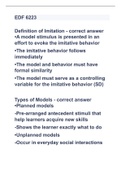
Definition of Imitation •A model stimulus is presented in an effort to evoke the imitative behavior •The imitative behavior follows immediately •The model and behavior must have formal similarity •The model must serve as a controlling variable for the imitative behavior (SD) Types of Models •Planned models -Pre-arranged antecedent stimuli that help learners acquire new skills -Shows the learner exactly what to do •Unplanned models -Occur in everyday social interactions 00:39 01:27 Formal Similarity •The model and the behavior physically resemble each other Immediacy •The temporal relation between the model and the occurrence of the imitative behavior is very important •Imitation may also occur at later times and in the context of everyday life situations -However, when this occurs in the absence of a model, it is not imitation The discriminative features of the environment are different in this context (i.e., the model is not controlling the behavior Controlled Relation •The controlling relation between the model and the imitative behavior is paramount •This is best evidenced when the model is novel and it still evokes an imitative response -After this first occurrence, the new behavior has a history of reinforcement -Becomes a discriminated operant Imitation Training •Some children with disabilities require instruction in order to learn to imitate •Objective: to teach children to "do what the model does" -Generalize a rule to imitate models -Also known as generalized imitation Steps to Imitation Training(Striefel, 1974) •Assess and teach any prerequisite skills for imitation training •Select models for training •Pretest •Sequence models for training •Perform imitation training Assessing/Teaching Prerequisite Skills •Prerequisite skills needed: -Attending (staying seated, keeping hands in lap, looking at teacher when name is called, looking at objects when prompted by teacher) -Problem behaviors that may interfere with training may need to be decreased Selecting Models for Training •Begin with selecting about 25 •Include gross and fine motor examples -Movement of body parts -Manipulation of physical objects •Use only one at a time (don't sequence them--save sequences for later) Pretesting •Purpose: to determine if individual already imitates some models •Procedures: -Get learner in "ready" position -If object to be used, place it in front of individual -Say learner's name, and then "do this" -Present the model -Immediately praise all responses with formal similarity to the model -Record learner's response as correct or incorrect Sequencing the Selected Models for Training •Arrange from easiest to most difficult •First models for training are ones the individual imitated correctly on some, but not all, pretest items •Next, teach ones the learner approximated but did incorrectly on pretest •Finally, teach items the learner did not perform or performed incorrectly on pretest Performing Imitation Training: Pre-Assessment •Pre-assessment -Purpose: evaluate learner's current performance level and determine progress in learning to respond to model -Brief pretest prior to each training session -Use first 3 models currently selected for training -Present them 3 times in random order -If learner performs them correctly 3 times, remove from training sequence 00:00 01:27 Performing Imitation Training: Training •Training -Use repeated presentations of 1 of the 3 models in pre-assessment -Use model most often responded to or responded to with closest similarity during pre-assessment -Continue until learner responds correctly 5 consecutive times -Use physical guidance if necessary, to prompt the response -Gradually fade prompts as quickly as possible Performing Imitation Training: Post Assessment •Post-assessment -Purpose: to evaluate how well learner can perform previously- and recently-learned behaviors -Present 5 previously learned models and 5 models still in training -On 3 consecutive post-assessments •If child has imitated a model incorrectly on 14 of 15 trials, remove it from training -Physical guidance may be used Performing Imitation Training: Probes •Probes for imitative behavior -Purpose: assesses for generalized imitation -Select 5 non-trained, novel models to check for occurrence of imitation -Do at end of each training session or intermix in training sessions Use pre-assessment procedures (no antecedent or response prompts
Document information
- Uploaded on
- May 7, 2023
- Number of pages
- 39
- Written in
- 2022/2023
- Type
- Exam (elaborations)
- Contains
- Questions & answers