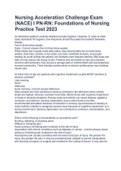
Nursing Acceleration Challenge Exam,Foundations of Nursing Practice Test 2023 Review
An Alzheimer patient is actively resistive to basic hygiene. However, in order to meet basic standards for hygiene, how frequently should the patient be bathed? Biweekly Weekly Two to three times weekly Daily - Correct answer-Two to three times weekly While adults don't usually need daily baths, they should bathe two to three times weekly. Grab bars, shower or tub seats, tub mats, handheld showers, and proper heating (to avoid chilling the patient) can facilitate more frequent bathing. Mild soap and bath oil may reduce the drying of skin. Patients who are fearful of tubs and showers, common with dementia, may receive a sponge bath or Comfort Bath with premoistened, warmed washcloths. Thick-handled toothbrushes or electric toothbrushes may facilitate mouth care. At which time of day are patients with cognitive impairment usually MOST sensitive to sensory overload? Late evening Noon Afternoon Early morning - Correct answer-Afternoon Many people are more sensitive to sensory overload in the afternoon when cortisol levels are highest. Sensory overload most often affects those with cognitive impairment or those in stressful situations. Excess noise and activity can cause distress, agitation, confusion, and delirium. Sensory deprivation occurs when there is too little environmental stimulation because of reduction in sensory input because of hearing or vision deficits, inability to recognize sensory input because of cognitive impairment, or a boring environment. Sensory deprivation can contribute to confusion, disorientation, and depression. Which of the following is characteristic of nociceptive pain? Burning, stabbing, or shooting pains Diffuse or cramping pain Acute aching or throbbing pain localized to the site of injury Association with chronic conditions such as diabetes or cancer - Correct answer-Acute aching or throbbing pain localized to the site of injury Nociceptive pain usually correlates with the extent and type of injury: the greater the injury, the greater the pain. It may be procedural pain (related to wound manipulation and dressing changes) or surgical pain (related to the cutting of tissue). It may also be continuous or cyclic, depending upon the type of injury. This type of pain, often described as aching or throbbing, is usually localized to the area of injury and resolves over time as healing takes place, and it usually responds to analgesia. According to the three-step World Health Organization (WHO) "analgesic ladder," a patient complaining of moderate to severe pain unresponsive to NSAIDs may require which of the following medications? Morphine Demerol Codeine Acetaminophen - Correct answer-Codeine Step 1: Mild to moderate pain is treated with aspirin, acetaminophen, and NSAIDs. Step 2: Moderate to severe pain unrelieved by Step 1 medications may need opioids, such as codeine, tramadol, or Percocet. Step 3: Severe pain without relief from Step 1 or Step 2 medications may need stronger opioids, such as morphine, Dilaudid, or MS-Contin Which type of precautions is indicated for a patient with a surgical-site infection and purulent discharge? Contact and droplet Airborne Droplet Contact - Correct answer-Contact Which of the following injection sites is the BEST choice for intramuscular (IM) administration of 3 mL of medication for a well-developed adult female of normal weight? Deltoid
Document information
- Uploaded on
- April 5, 2023
- Number of pages
- 6
- Written in
- 2022/2023
- Type
- Exam (elaborations)
- Contains
- Questions & answers