

The Jaguar
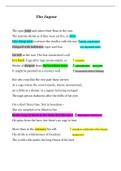
The apes yawn and adore their fleas in the sun.
The parrots shriek as if they were on fire, or strut
Like cheap tarts to attract the stroller with the nut. *simile -captivation
Fatigued with indolence, tiger and lion has degraded them
Lie still as the sun. The boa-constrictor’s coil
Is a fossil. Cage after cage seems empty, or * metaphor
Stinks of sleepers from the breathing straw. * personification – more alive
It might be painted on a nursery wall. * the semantic field of lethargy
But who runs like the rest past these arrives
At a cage where the crowd stands, stares, mesmerized,
As a child at a dream, at a jaguar hurrying enraged
Through prison darkness after the drills of his eyes
On a short fierce fuse. Not in boredom—
The eye satisfied to be blind in fire,
By the bang of blood in the brain deaf the ear— * alliteration / plosive ‘b’
He spins from the bars, but there’s no cage to him
More than to the visionary his cell: * metaphor; celebration of the human
His stride is wildernesses of freedom: imagination
The world rolls under the long thrust of his heel.
, Over the cage floor the horizons come.
This poem opens with a line that gives us no indication that the poem is about animals in captivation. It
is not until we read on that we realise that these apes are ‘yawning’ out of boredom at their captivated
existence. The speaker then proceeds to depict how the majority of the caged animals at the zoo have
become resigned to their state of captivation. They have been forced into submission and this is
reflected in the language which is in the semantic field of lethargy and idleness. Diction such as “yawn”;
“Fatigued with indolence”; “Lie still” convey the unnatural inertia of these innately wild and vivacious
animals. The boa constrictor is so inactive that “his coil is a fossil”. This metaphor effectively conveys
the lack of motivation that is caused by being imprisoned. The parrots are depicted as having been
degraded by their captivation as they “strut/ Like cheap tarts” to attain the sustenance that would be
freely available to them in their natural habitat.
The stagnation of these caged animals is so poignant that “Cage after cage seems empty”. This sense of
emptiness echoes the emptiness of the existence of these animals in captivation. The word “cage” in
this line is the first concrete indication that the animals are in a zoo and the repetition of the hard
sounding word “cage” reflects the speaker’s distain at the imprisonment of these animals.
This unnatural state of stagnation caused by the incarceration of these animals is then starkly
contrasted with a portrayal of the jaguar. The tone of the poem changes in the third stanza as indicated
by the word “But…” The jaguar, despite the fact that it is the most endangered species of them all, has
maintained his sense of freedom which confers upon him a power that the other caged animals do not
possess. Vitality and lethargy manifest themselves, at the extreme, in the fundamentally different
The apes yawn and adore their fleas in the sun.
The parrots shriek as if they were on fire, or strut
Like cheap tarts to attract the stroller with the nut. *simile -captivation
Fatigued with indolence, tiger and lion has degraded them
Lie still as the sun. The boa-constrictor’s coil
Is a fossil. Cage after cage seems empty, or * metaphor
Stinks of sleepers from the breathing straw. * personification – more alive
It might be painted on a nursery wall. * the semantic field of lethargy
But who runs like the rest past these arrives
At a cage where the crowd stands, stares, mesmerized,
As a child at a dream, at a jaguar hurrying enraged
Through prison darkness after the drills of his eyes
On a short fierce fuse. Not in boredom—
The eye satisfied to be blind in fire,
By the bang of blood in the brain deaf the ear— * alliteration / plosive ‘b’
He spins from the bars, but there’s no cage to him
More than to the visionary his cell: * metaphor; celebration of the human
His stride is wildernesses of freedom: imagination
The world rolls under the long thrust of his heel.
, Over the cage floor the horizons come.
This poem opens with a line that gives us no indication that the poem is about animals in captivation. It
is not until we read on that we realise that these apes are ‘yawning’ out of boredom at their captivated
existence. The speaker then proceeds to depict how the majority of the caged animals at the zoo have
become resigned to their state of captivation. They have been forced into submission and this is
reflected in the language which is in the semantic field of lethargy and idleness. Diction such as “yawn”;
“Fatigued with indolence”; “Lie still” convey the unnatural inertia of these innately wild and vivacious
animals. The boa constrictor is so inactive that “his coil is a fossil”. This metaphor effectively conveys
the lack of motivation that is caused by being imprisoned. The parrots are depicted as having been
degraded by their captivation as they “strut/ Like cheap tarts” to attain the sustenance that would be
freely available to them in their natural habitat.
The stagnation of these caged animals is so poignant that “Cage after cage seems empty”. This sense of
emptiness echoes the emptiness of the existence of these animals in captivation. The word “cage” in
this line is the first concrete indication that the animals are in a zoo and the repetition of the hard
sounding word “cage” reflects the speaker’s distain at the imprisonment of these animals.
This unnatural state of stagnation caused by the incarceration of these animals is then starkly
contrasted with a portrayal of the jaguar. The tone of the poem changes in the third stanza as indicated
by the word “But…” The jaguar, despite the fact that it is the most endangered species of them all, has
maintained his sense of freedom which confers upon him a power that the other caged animals do not
possess. Vitality and lethargy manifest themselves, at the extreme, in the fundamentally different


