
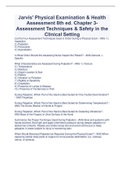
Jarvis' Physical Examination & Health Assessment 8th ed. Chapter 3- Assessment Techniques & Safety in the Clinical Setting
Jarvis' Physical Examination & Health Assessment 8th ed. Chapter 3- Assessment Techniques & Safety in the Clinical Setting List the Four Assessment Techniques Used in Order During a Physical Exam - ANS-1.) Inspection 2.) Palpation 3.) Percussion 4.) Auscultation In What Order Should the Assessing Nurse Inspect the Patient? - ANS-General - Specific What Characteristics are Assessed During Palpation? - ANS-1.) Texture 2.) Temperature 3.) Moisture 4.) Organ Location & Size 5.) Edema 6.) Vibration or Pulsation 7.) Rigidity or Spasticity 8.) Crepitation 9.) Presence of Lumps or Masses 10.) Presence of Tenderness or Pain During Palpation, Which Part of the Hand is Best Suited for Fine Tactile Discrimination? - ANS-Fingertips During Palpation, Which Part of the Hand is Best Suited for Determining Temperature? - ANS-The Dorsa (Backs) of Hands & Fingers During Palpation, Which Part of the Hand is Best Suited for Detecting Vibrations? - ANS-Base of the Fingers or Ulnar Surface of the Hand Summarize the Proper Technique Used During Palpation - ANS-Slow and systemic with hands warmed. Start light and apply intermittent pressure during deeper palpation of abdominal contents. Palpate any tender areas last and avoid continuous or deep palpation in areas subject to injury or worsening pain. When Would Bimanual Palpation be Required During the Physical Exam? - ANS-When capturing certain body parts or organs for more precise delimitation (i.e., kidneys, uterus, or adnexa). Continues...
Document information
- Uploaded on
- April 3, 2023
- Number of pages
- 4
- Written in
- 2022/2023
- Type
- Exam (elaborations)
- Contains
- Questions & answers


