Summary of the hand of project management | Remco van der Schoot
16. CHAPTER 16 – MANAGING COST AND EARNED VAL UE (P.247-263)
Earned Value Management (EVM) = a methodology used to measure and communicate the real physical progress
of a project and to integrate the three critical elements of project management (scope, time and cost
management). It takes into account the following factors:
➢ the work completed.
➢ the time taken.
➢ the costs incurred to complete the project.
16.1. MANAGING COSTS
Project performance should be measured throughout the entire life of the project at regular time intervals. The
ideal point of reference is a fixed time frame known as the baseline schedule of the project. Having knowledge
about activity costs, this baseline schedule can be translated into a time-phased planned value for each activity
and for the total project.
➢ The baseline schedule of the project can be constructed with project scheduling techniques such as he
critical path method (CPM) and defines start times (and finish times) for each project activity.
16.1.1. KEY METRICS
The planned duration (PD) = the total project duration as a result of the constructed CPM schedule or its resource
related extensions and is often referred to as schedule at completion (SAC)
The actual time (AT) = the number of time periods (for example, weeks) the project is in progress at the current
time instance.
The real duration (RD) = the real final project duration known upon the project’s finish.
The budget at completion (BAC) = the sum of all budgeted costs for the individual activities
The Planned Value (PV) = the time-phased budget baseline as an immediate translation of the schedule
constructed from the project network using well-known CPM project scheduling techniques and measures how
much value should have been earned according to the baseline schedule.
➢ The cumulative increase in the total budgeted activity cost given the start and finish times stipulated in
the baseline schedule.
➢ The PV is often called budgeted cost of work scheduled (BCWS).
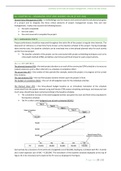
Each activity has a duration of one week and a budgeted cost of €20,000, leading to a schedule with PD = 5 weeks
and a total expected cost of BAC = €100,000. The translation of the baseline schedule displayed at the top of
Figure 16.1 into monetary terms leads to the PV curve as displayed in the figure.
P a g i n a 29 | 53
, Summary of the hand of project management | Remco van der Schoot
Actual Cost (AC) or actual cost of work performed (ACWP) = cumulative actual cost spent at a given point AT in
time and measures the actual cost incurred up to the current time.
Earned Value (EV) or budgeted cost of work performed (BCWP) = the amount budgeted for performing the work
that was accomplished at a given point AT in time and measures how much value has been earned at the current
time.
➢ Equals the total activity (or project) BAC multiplied by the percentage activity (or project) completion
(PC) at the particular point in time (= PC * BAC).
The following conclusions can be made:
➢ Since the baseline schedule (PV) stipulates that €5,000 more should have been earned than actually
earned (EV) at week 3, the project is clearly late.
➢ Since the value of the work done up to now (AC) exceeds the value that should have been earned with
that current work done as stipulated in the baseline schedule (EV), the project is clearly over budget
16.1.2. PERFORMANCE MEASURMENTS
Time and cost deviations (underruns and overruns) can be expressed by variances or unitless indicators, as
discussed in the two following sections.
Variances: Project performance, both in terms of time and cost, is determined by comparing the three key
parameters PV, AC and EV, resulting in two well-known performance variances:
➢ Schedule variance -> (SV = EV − PV)
o = 0: project on schedule
o < 0: project delay
o > 0: project ahead of schedule
P a g i n a 30 | 53
16. CHAPTER 16 – MANAGING COST AND EARNED VAL UE (P.247-263)
Earned Value Management (EVM) = a methodology used to measure and communicate the real physical progress
of a project and to integrate the three critical elements of project management (scope, time and cost
management). It takes into account the following factors:
➢ the work completed.
➢ the time taken.
➢ the costs incurred to complete the project.
16.1. MANAGING COSTS
Project performance should be measured throughout the entire life of the project at regular time intervals. The
ideal point of reference is a fixed time frame known as the baseline schedule of the project. Having knowledge
about activity costs, this baseline schedule can be translated into a time-phased planned value for each activity
and for the total project.
➢ The baseline schedule of the project can be constructed with project scheduling techniques such as he
critical path method (CPM) and defines start times (and finish times) for each project activity.
16.1.1. KEY METRICS
The planned duration (PD) = the total project duration as a result of the constructed CPM schedule or its resource
related extensions and is often referred to as schedule at completion (SAC)
The actual time (AT) = the number of time periods (for example, weeks) the project is in progress at the current
time instance.
The real duration (RD) = the real final project duration known upon the project’s finish.
The budget at completion (BAC) = the sum of all budgeted costs for the individual activities
The Planned Value (PV) = the time-phased budget baseline as an immediate translation of the schedule
constructed from the project network using well-known CPM project scheduling techniques and measures how
much value should have been earned according to the baseline schedule.
➢ The cumulative increase in the total budgeted activity cost given the start and finish times stipulated in
the baseline schedule.
➢ The PV is often called budgeted cost of work scheduled (BCWS).
Each activity has a duration of one week and a budgeted cost of €20,000, leading to a schedule with PD = 5 weeks
and a total expected cost of BAC = €100,000. The translation of the baseline schedule displayed at the top of
Figure 16.1 into monetary terms leads to the PV curve as displayed in the figure.
P a g i n a 29 | 53
, Summary of the hand of project management | Remco van der Schoot
Actual Cost (AC) or actual cost of work performed (ACWP) = cumulative actual cost spent at a given point AT in
time and measures the actual cost incurred up to the current time.
Earned Value (EV) or budgeted cost of work performed (BCWP) = the amount budgeted for performing the work
that was accomplished at a given point AT in time and measures how much value has been earned at the current
time.
➢ Equals the total activity (or project) BAC multiplied by the percentage activity (or project) completion
(PC) at the particular point in time (= PC * BAC).
The following conclusions can be made:
➢ Since the baseline schedule (PV) stipulates that €5,000 more should have been earned than actually
earned (EV) at week 3, the project is clearly late.
➢ Since the value of the work done up to now (AC) exceeds the value that should have been earned with
that current work done as stipulated in the baseline schedule (EV), the project is clearly over budget
16.1.2. PERFORMANCE MEASURMENTS
Time and cost deviations (underruns and overruns) can be expressed by variances or unitless indicators, as
discussed in the two following sections.
Variances: Project performance, both in terms of time and cost, is determined by comparing the three key
parameters PV, AC and EV, resulting in two well-known performance variances:
➢ Schedule variance -> (SV = EV − PV)
o = 0: project on schedule
o < 0: project delay
o > 0: project ahead of schedule
P a g i n a 30 | 53