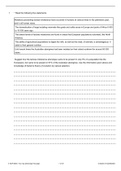
1 * Read the following five statements.
Mutations preventing lactose intolerance have occurred in humans at various times in the prehistoric past,
and in all human races.
The domestication of large lactating mammals like goats and cattle arose in Europe and parts of Africa 5 000
to 10 000 years ago.
The lowest levels of lactose intolerance are found in areas that European populations colonised, like North
America.
The ability of agricultural populations to digest the milk, as well as the meat, of animals, is advantageous. It
adds to their general nutrition.
Until recent times the Australian aborigines had been isolated on their island continent for around 50 000
years.
Suggest how the lactose intolerance phenotype came to be present in only 5% of a population like the
Europeans, but came to be present in 97% of the Australian aborigines. Use the information given above and
knowledge of Darwin's theory of evolution by natural selection.
© OCR 2023. You may photocopy this page. 1 of 37 Created in ExamBuilder
, [9]
2 Bats are the only mammals that have wings. Many species of bat hunt flying insects at night. Bats are able to
use echolocation (sound waves) in order to help them find their prey in the dark.
(i) Explain why bats and birds, despite not being closely related, have both evolved wings.
[3]
(ii) Suggest why the vast majority of bird species have not evolved the ability to echolocate.
[1]
© OCR 2023. You may photocopy this page. 2 of 37 Created in ExamBuilder
, 3 These two organisms show very similar anatomical adaptations but are classified in different taxonomic groups.
What is this an example of?
A convergent evolution
B divergent evolution
C disruptive selection
D stabilising selection
Your answer
[1]
© OCR 2023. You may photocopy this page. 3 of 37 Created in ExamBuilder
, 4(a) In his book ‘On the Origin of Species’, Charles Darwin made the following four observations.
E Offspring generally appear similar to their parents.
F No two individuals are identical.
G Organisms have the ability to produce large numbers of offspring.
H Populations in nature tend to remain relatively stable.
From these observations he made a number of deductions, listed in the table below.
The deductions are supported by one or more of the observations (E, F, G or H).
In the table, indicate which of the above observations contributed to each deduction.
You may use each letter (E, F, G, or H) once, more than once, or not at all.
Deduction Supporting observation(s)
Characteristics are passed on to the next generation.
There is a struggle for existence.
Individuals with beneficial characteristics are among the few who survive.
[3]
(b) Explain how biological molecules can provide evidence that species have evolved.
You should refer to different types of molecule in your answer.
[4]
© OCR 2023. You may photocopy this page. 4 of 37 Created in ExamBuilder
Mutations preventing lactose intolerance have occurred in humans at various times in the prehistoric past,
and in all human races.
The domestication of large lactating mammals like goats and cattle arose in Europe and parts of Africa 5 000
to 10 000 years ago.
The lowest levels of lactose intolerance are found in areas that European populations colonised, like North
America.
The ability of agricultural populations to digest the milk, as well as the meat, of animals, is advantageous. It
adds to their general nutrition.
Until recent times the Australian aborigines had been isolated on their island continent for around 50 000
years.
Suggest how the lactose intolerance phenotype came to be present in only 5% of a population like the
Europeans, but came to be present in 97% of the Australian aborigines. Use the information given above and
knowledge of Darwin's theory of evolution by natural selection.
© OCR 2023. You may photocopy this page. 1 of 37 Created in ExamBuilder
, [9]
2 Bats are the only mammals that have wings. Many species of bat hunt flying insects at night. Bats are able to
use echolocation (sound waves) in order to help them find their prey in the dark.
(i) Explain why bats and birds, despite not being closely related, have both evolved wings.
[3]
(ii) Suggest why the vast majority of bird species have not evolved the ability to echolocate.
[1]
© OCR 2023. You may photocopy this page. 2 of 37 Created in ExamBuilder
, 3 These two organisms show very similar anatomical adaptations but are classified in different taxonomic groups.
What is this an example of?
A convergent evolution
B divergent evolution
C disruptive selection
D stabilising selection
Your answer
[1]
© OCR 2023. You may photocopy this page. 3 of 37 Created in ExamBuilder
, 4(a) In his book ‘On the Origin of Species’, Charles Darwin made the following four observations.
E Offspring generally appear similar to their parents.
F No two individuals are identical.
G Organisms have the ability to produce large numbers of offspring.
H Populations in nature tend to remain relatively stable.
From these observations he made a number of deductions, listed in the table below.
The deductions are supported by one or more of the observations (E, F, G or H).
In the table, indicate which of the above observations contributed to each deduction.
You may use each letter (E, F, G, or H) once, more than once, or not at all.
Deduction Supporting observation(s)
Characteristics are passed on to the next generation.
There is a struggle for existence.
Individuals with beneficial characteristics are among the few who survive.
[3]
(b) Explain how biological molecules can provide evidence that species have evolved.
You should refer to different types of molecule in your answer.
[4]
© OCR 2023. You may photocopy this page. 4 of 37 Created in ExamBuilder