ATLS Practice Test 2 QUESTIONS AND ANSWERS
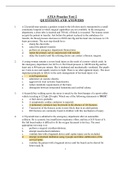
ATLS Practice Test 2 QUESTIONS AND ANSWERS 1. A 22yearold man sustains a gunshot wound to the left chest and is transported to a small community hospital at which surgical capabilities are not available. In the emergency department, a chest tube is inserted and 700 mL of blood is evacuated. The trauma center accepts the patient in transfer. Just before the patient is placed in the ambulance for transfer, his blood pressure decreases to 80/68 mm Hg and his heart rate increases to 136 beats per minute. The next step should be to: a. clamp the chest tube. b. cancel the patient's transfer. c. perform an emergency department thoracotomy. d. repeat the primary survey and proceed with transfer. e. delay the transfer until the referring doctor can contact a thoracic surgeon. 2. A young woman sustains a severe head injury as the result of a motor vehicle crash. In the emergency department, her GCS is 6. Her blood pressure is 140/90 mm Hg and her heart rate is 80 beats per minute. She is intubated and mechanically ventilated. Her pupils are 3 mm in size and equally reactive to light. There is no other apparent injury. The most important principle to follow in the early management of her head injury is to: a. avoid hypotension. b. administer an osmotic diuretic. c. aggressively treat systemic hypertension. d. reduce metabolic requirements of the brain. e. distinguish between intracranial hematoma and cerebral edema. 3. A 6yearold boy walking across the street is struck by the front bumper of a sports utility vehicle traveling at 32 kph (20 mph). Which one of the following statements is TRUE? a. A flail chest is probable. b. A symptomatic cardiac contusion is expected. c. A pulmonary contusion may be present in the absence of rib fractures. d. Transection of the thoracic aorta is more likely than in an adult patient. e. Rib fractures are commonly found in children with this mechanism of injury. 4. A 39yearold man is admitted to the emergency department after an automobile collision. He is cyanotic, has insufficient respiratory effort, and has a GCS Score of 6. His full beard makes it difficult to fit the oxygen facemask to his face. The most appropriate next step is to: a. perform a surgical cricothyroidotomy. b. attempt nasotracheal intubation. c. ventilate him with a bagmask device until cspine injury can be excluded. d. attempt orotracheal intubation using 2 people and inline stabilization of the cervical spine. e. ventilate the patient with a bagmask device until his beard can be shaved for better mask fit. 5. A patient is brought to the emergency department 20 minutes after a motor vehicle crash. He is conscious and there is no obvious external trauma. He arrives at the hospital completely immobilized on a long spine board. His blood pressure is 60/40 mm Hg and his heart rate is 70 beats per minute. His skin is warm. Which one of the following statements is TRUE? a. Vasoactive medications have no role in this patient's management. b. The hypotension should be managed with volume resuscitation alone. c. Flexion and extension views of the cspine should be performed early. d. Occult abdominal visceral injuries can be excluded as a cause of hypotension. e. Flaccidity of the lower extremities and loss of deep tendon reflexes are expected.
Document information
- Uploaded on
- March 29, 2023
- Number of pages
- 10
- Written in
- 2022/2023
- Type
- Exam (elaborations)
- Contains
- Questions & answers