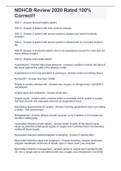
NDHCB Review 2020 Rated 100%
Correct!!
ASA 1 - Answer Normal healthy patient
ASA 2 - Answer A patient with mild systemic disease
ASA 3 - Answer A patient with severe systemic disease and some functional
limitation
ASA 4 - Answer A patient with severe systemic disease that is a constant threat to
life
ASA 5 - Answer A moribund patient who is not expected to survive for more than 24
hours without surgery
ASA 6 - Answer brain dead patient
Hypertension - Answer high blood pressure - common condition in which the force of
the blood against the walls of the arteries is high
Hypertension is the most prevalent in causing a - Answer stroke and kidney failure
Normal BP - Answer less than 120/80
Angian is usually relieved with - Answer rest, oxygen, or nitroglycerine. Call EMS if
not relieved
Angina signs and symptoms - Answer chest pain
Angian cause - Answer when coronary artery is narrowed and is unable to supple
the heart muscle with adequate amounts of oxygenated blood
Scheduling appointments for angina - Answer morning appointment due to providing
a stress - free environment
Nitroglycerine - Answer relaxes smooth muscles. up to 3 tablets in 15 minutes can
be taken sublingually
myocardial infraction (heart attack) - Answer death of parts of the heart muscle
cause by ischemia (inadequate supply of oxygen and nutrients) blood clot develops
cutting off blood supply
Myocardial infarction dental treatment scheduling - Answer 6 months after
Myocardial infarction signs and symptoms - Answer sweating, nausea, weakness,
irregular heartbeats, shortness of breath, pain in chest; neck; jaw; shoulder
Myocardial infraction management - Answer similar to angina but if symptoms last
30. min or longer and is not relieved with rest, oxygen, and nitroglycerin. Call EMS
,NDHCB Review 2020 Rated 100%
Correct!!
place in semi supine or upright position, provide a single dose 162mg to 325 mg of
aspirin to be chewed
congestive heart failure (CHF) - Answer heart pumping power is weaker and cannot
provide enough oxygen, blood, and nutrients to the body.
Arrhythmias - Answer abnormal electrical conduction to the heart muscle, heart
requires a pace maker and or implant defibrillator
attention-deficit/hyperactivity disorder (ADHD) - Answer Condition of inattentive,
hyperactivity, impulsiveness, and possible learning disability. schedule short
appointments, use tell-show-do approach.
Alzheimers Disease - Answer progressive disease that destroys memory and other
important mental functions
Oral conditions related to Alzheimer's disease - Answer angular shelties, glossitis,
loss of taste, root caries, periodontal disease, xerostomia from rx drugs
Parkinsons Disease - Answer Neurological disorder caused by the death ( or
impairment) of dopamine - producing neutrons in the basal ganglia of the brain
Parkinson disease symptoms - Answer tremors, loss of coordination, rigidity, loss of
facial expression, slow movement, drooling, difficult swallowing
Parkinson Disease pt during treatment - Answer protect airways to prevent choking
due to pt having difficulty of swallowing, stabilize patients hands using aids to
prevent injuries that can be cause by patient tremors.
Oral conditions associated with Parkinson disease - Answer xerostomia related to
meds
Cerebrovascular Accident (Stroke) - Answer A blood vessel in the brain is blocked
(or ruptured) and prevents oxygen from reaching that part of the brain
Ischemic stroke - Answer Blood vessel is obstructed, composes the majority of
strokes
Thrombotic strike - Answer blood clot (thrombus) forms in one of the arteries of the
brain
Embolic stroke - Answer Blood clot or other debris in the body travels through the
bloodstream, ends in a narrower brain artery and blocks it
Hemorrhagic stroke - Answer blood vessel is ruptured in the brain
Stroke Symptoms - Answer weakness, difficulty speaking, severe headache,
dizziness, loss of balance, visual impairment, and drooling on affected side
, NDHCB Review 2020 Rated 100%
Correct!!
Stoke protocol - Answer Call 911
Do not treat 6 months post attack
oral conditions related to stoke - Answer xerostomia from meds
Epilepsy - Answer Group of nervous system disorders in which the nerve cell activity
in the brain becomes disrupted
Seizure - Answer uncontrolled electrical activity in the brain.Produces convulsion,
thought disturbance, abnormal behaviour, etc.
Petite mal seizure - Answer (mild) characterized by sudden pause with the patient
staring into space. can last a few seconds or minutes
Grand mal seizures - Answer (severe) loss of consciousness accompanied by tonic
convulsions (body becomes stiff) followed by clonic convulsions (body shakes)
Oral conditions related to Epilepsy - Answer Gingival hyperplasia from meds
(Dilantin)
Seizure management - Answer leave pt in supine position role to side, clear of
dangerous objects, put cushion under head, do NOT restrain pt or put a tongue
depressor into pt mouth, allow pt to rest after event
Dental treatment related to epilepsy DO's - Answer avoid brightening light in pt eyes
as it can trigger seizure
Depression - Answer Hormone and chemical imbalance that can provoke sadness,
insomnia, memory, difficulty, etc
Oral conditions related to depression - Answer xerostomia
Schizophrenia - Answer condition caused by excessive dopamines and serotonin
levels, storms include hallucinations and disordered thoughts.
obsessive-compulsive disorder (OCD) - Answer unreasonable thoughts that lead to
doing repetitive behaviours or compulsions. Oral conditions xerostomia related to
meds
Alcohol decency pt avoid use of - Answer Alcohol-containing mouthwashes and
nitrous
Fetal Alcohol Syndrom Symptoms - Answer Mental, behavioural, and or learning
disabilities, seizures, and poor muscle coordination
Correct!!
ASA 1 - Answer Normal healthy patient
ASA 2 - Answer A patient with mild systemic disease
ASA 3 - Answer A patient with severe systemic disease and some functional
limitation
ASA 4 - Answer A patient with severe systemic disease that is a constant threat to
life
ASA 5 - Answer A moribund patient who is not expected to survive for more than 24
hours without surgery
ASA 6 - Answer brain dead patient
Hypertension - Answer high blood pressure - common condition in which the force of
the blood against the walls of the arteries is high
Hypertension is the most prevalent in causing a - Answer stroke and kidney failure
Normal BP - Answer less than 120/80
Angian is usually relieved with - Answer rest, oxygen, or nitroglycerine. Call EMS if
not relieved
Angina signs and symptoms - Answer chest pain
Angian cause - Answer when coronary artery is narrowed and is unable to supple
the heart muscle with adequate amounts of oxygenated blood
Scheduling appointments for angina - Answer morning appointment due to providing
a stress - free environment
Nitroglycerine - Answer relaxes smooth muscles. up to 3 tablets in 15 minutes can
be taken sublingually
myocardial infraction (heart attack) - Answer death of parts of the heart muscle
cause by ischemia (inadequate supply of oxygen and nutrients) blood clot develops
cutting off blood supply
Myocardial infarction dental treatment scheduling - Answer 6 months after
Myocardial infarction signs and symptoms - Answer sweating, nausea, weakness,
irregular heartbeats, shortness of breath, pain in chest; neck; jaw; shoulder
Myocardial infraction management - Answer similar to angina but if symptoms last
30. min or longer and is not relieved with rest, oxygen, and nitroglycerin. Call EMS
,NDHCB Review 2020 Rated 100%
Correct!!
place in semi supine or upright position, provide a single dose 162mg to 325 mg of
aspirin to be chewed
congestive heart failure (CHF) - Answer heart pumping power is weaker and cannot
provide enough oxygen, blood, and nutrients to the body.
Arrhythmias - Answer abnormal electrical conduction to the heart muscle, heart
requires a pace maker and or implant defibrillator
attention-deficit/hyperactivity disorder (ADHD) - Answer Condition of inattentive,
hyperactivity, impulsiveness, and possible learning disability. schedule short
appointments, use tell-show-do approach.
Alzheimers Disease - Answer progressive disease that destroys memory and other
important mental functions
Oral conditions related to Alzheimer's disease - Answer angular shelties, glossitis,
loss of taste, root caries, periodontal disease, xerostomia from rx drugs
Parkinsons Disease - Answer Neurological disorder caused by the death ( or
impairment) of dopamine - producing neutrons in the basal ganglia of the brain
Parkinson disease symptoms - Answer tremors, loss of coordination, rigidity, loss of
facial expression, slow movement, drooling, difficult swallowing
Parkinson Disease pt during treatment - Answer protect airways to prevent choking
due to pt having difficulty of swallowing, stabilize patients hands using aids to
prevent injuries that can be cause by patient tremors.
Oral conditions associated with Parkinson disease - Answer xerostomia related to
meds
Cerebrovascular Accident (Stroke) - Answer A blood vessel in the brain is blocked
(or ruptured) and prevents oxygen from reaching that part of the brain
Ischemic stroke - Answer Blood vessel is obstructed, composes the majority of
strokes
Thrombotic strike - Answer blood clot (thrombus) forms in one of the arteries of the
brain
Embolic stroke - Answer Blood clot or other debris in the body travels through the
bloodstream, ends in a narrower brain artery and blocks it
Hemorrhagic stroke - Answer blood vessel is ruptured in the brain
Stroke Symptoms - Answer weakness, difficulty speaking, severe headache,
dizziness, loss of balance, visual impairment, and drooling on affected side
, NDHCB Review 2020 Rated 100%
Correct!!
Stoke protocol - Answer Call 911
Do not treat 6 months post attack
oral conditions related to stoke - Answer xerostomia from meds
Epilepsy - Answer Group of nervous system disorders in which the nerve cell activity
in the brain becomes disrupted
Seizure - Answer uncontrolled electrical activity in the brain.Produces convulsion,
thought disturbance, abnormal behaviour, etc.
Petite mal seizure - Answer (mild) characterized by sudden pause with the patient
staring into space. can last a few seconds or minutes
Grand mal seizures - Answer (severe) loss of consciousness accompanied by tonic
convulsions (body becomes stiff) followed by clonic convulsions (body shakes)
Oral conditions related to Epilepsy - Answer Gingival hyperplasia from meds
(Dilantin)
Seizure management - Answer leave pt in supine position role to side, clear of
dangerous objects, put cushion under head, do NOT restrain pt or put a tongue
depressor into pt mouth, allow pt to rest after event
Dental treatment related to epilepsy DO's - Answer avoid brightening light in pt eyes
as it can trigger seizure
Depression - Answer Hormone and chemical imbalance that can provoke sadness,
insomnia, memory, difficulty, etc
Oral conditions related to depression - Answer xerostomia
Schizophrenia - Answer condition caused by excessive dopamines and serotonin
levels, storms include hallucinations and disordered thoughts.
obsessive-compulsive disorder (OCD) - Answer unreasonable thoughts that lead to
doing repetitive behaviours or compulsions. Oral conditions xerostomia related to
meds
Alcohol decency pt avoid use of - Answer Alcohol-containing mouthwashes and
nitrous
Fetal Alcohol Syndrom Symptoms - Answer Mental, behavioural, and or learning
disabilities, seizures, and poor muscle coordination