A Cook 2015
Chemistry Led Specification Revision
Chapter 2 - Chemical Bonding and Structure
Topic 2A - Bonding
(a) Know that ionic bonding is the strong electrostatic attraction between oppositely charged ions
Ionic Bonding: THE ELECTROSTATIC ATTRACTION BETWEEN OPPOSITE CHARGED IONS
The nature of ionic bonding:
• Ionic bonding is confined to solid materials consisting of a regular array of oppositely charged
ions extending throughout a giant lattice network
• Most familiar ionic compound is sodium chloride, NaCl. It consists of a regular array of Sodium
ions, Na+ and chloride ions, Cl-.
• In an ionic solid, there are strong electrostatic attractions between ions.
• Ions arranged to that opposite electrostatic attractions can exist to be stronger than the repulsion
of ions with the same charge
Factor effecting ionic bonding:
• The electrostatic interaction between ions is not directional: all that matters is the distance
between two ions, not their orientation with respect to one another.
The strength of ionic bonding:
• The strength of an ionic bond can be calculated by working out the energy required in one mole
of solid to separate the ions to infinity (to the gas phase).
• When they are at an infinite distance from one another the ions can no longer interact.
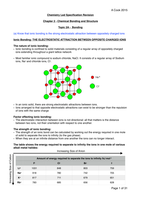
The table shows the energy required to separate to infinity the ions in one mole of various
alkali metal halides:
Increasing Size of Anion
Increasing Size of Cation
Amount of energy required to separate the ions to infinity /kJ mol-1
F- Cl- Br- I-
Li+ 1031 848 803 759
Na+ 918 780 742 705
K+ 817 711 679 651
Rb+ 783 685 656 628
Page 1 of 31
Chemistry Led Specification Revision
Chapter 2 - Chemical Bonding and Structure
Topic 2A - Bonding
(a) Know that ionic bonding is the strong electrostatic attraction between oppositely charged ions
Ionic Bonding: THE ELECTROSTATIC ATTRACTION BETWEEN OPPOSITE CHARGED IONS
The nature of ionic bonding:
• Ionic bonding is confined to solid materials consisting of a regular array of oppositely charged
ions extending throughout a giant lattice network
• Most familiar ionic compound is sodium chloride, NaCl. It consists of a regular array of Sodium
ions, Na+ and chloride ions, Cl-.
• In an ionic solid, there are strong electrostatic attractions between ions.
• Ions arranged to that opposite electrostatic attractions can exist to be stronger than the repulsion
of ions with the same charge
Factor effecting ionic bonding:
• The electrostatic interaction between ions is not directional: all that matters is the distance
between two ions, not their orientation with respect to one another.
The strength of ionic bonding:
• The strength of an ionic bond can be calculated by working out the energy required in one mole
of solid to separate the ions to infinity (to the gas phase).
• When they are at an infinite distance from one another the ions can no longer interact.
The table shows the energy required to separate to infinity the ions in one mole of various
alkali metal halides:
Increasing Size of Anion
Increasing Size of Cation
Amount of energy required to separate the ions to infinity /kJ mol-1
F- Cl- Br- I-
Li+ 1031 848 803 759
Na+ 918 780 742 705
K+ 817 711 679 651
Rb+ 783 685 656 628
Page 1 of 31