
NRNP 6566 Final Exam Study Guide
Week 6 and 7
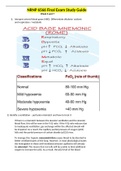
1. Interpret arterial blood gases (ABG). Differentiate alkalosis/ acidosis
and respiratory / metabolic
2. Identify a ventilation – perfusion mismatch and how to treat it
If there is a mismatch between the alveolar ventilation and the alveolar
blood flow, this will be seen in the V/Q ratio. If the V/Q ratio reduces due
to inadequate ventilation, gas exchange within the affected alveoli will
be impaired. As a result, the capillary partial pressure of oxygen (pO2)
falls and the partial pressure of carbon dioxide (pCO2) rises.
To manage this, hypoxic vasoconstriction causes blood to be diverted to
better ventilated parts of the lung. However, in most physiological states
the hemoglobin in these well-ventilated alveolar capillaries will already
be saturated. This means that red cells will be unable to bind additional
oxygen to increase the pO2. As a result, the pO2 level of the blood
, remains low, which acts as a stimulus to cause hyperventilation, resulting
in either normal or low CO2 levels.
A mismatch in ventilation and perfusion can arise due to either reduced
ventilation of part of the lung or reduced perfusion.
Ventilation/perfusion mismatch — Mechanical ventilation can alter two
opposing forms of ventilation/perfusion mismatch (V/Q mismatch), dead
space (areas that are overventilated relative to perfusion; V>Q) and
shunt (areas that are underventilated relative to perfusion; V<Q). By
increasing ventilation (V), the institution of positive pressure ventilation
will worsen dead space but improve shunt.
Increased dead space — Dead space reflects the surface area within the
lung that is not involved in gas exchange. It is the sum of the anatomic
plus alveolar dead space. Alveolar dead space (also known as physiologic
dead space) consists of alveoli that are not involved in gas exchange due
to insufficient perfusion (ie, overventilated relative to perfusion).
Positive pressure ventilation tends to increase alveolar dead space by
increasing ventilation in alveoli that do not have a corresponding
increase in perfusion, thereby worsening V/Q mismatch and
hypercapnia.
Reduced shunt — An intraparenchymal shunt exists where there is blood
flow through pulmonary parenchyma that is not involved in gas
exchange because of insufficient alveolar ventilation. Patients with
respiratory failure frequently have increased intraparenchymal shunting
due to areas of focal atelectasis that continue to be perfused (ie, regions
that are underventilated relative to perfusion). Treating atelectasis with
positive pressure ventilation can reduce intraparenchymal shunting by
improving alveolar ventilation, thereby improving V/Q matching and
oxygenation.
This is particularly true if PEEP is added. (See "Positive end-expiratory
pressure (PEEP)" and "Measures of oxygenation and mechanisms of
hypoxemia", section on 'V/Q mismatch'.)
3. Be able to calculate an Aa gradient. Be able to interpret an Aa gradient.
The alveolar to arterial (A-a) oxygen gradient is a common measure of
oxygenation ("A" denotes alveolar and "a" denotes arterial
oxygenation). It is the difference between the amount of the oxygen in
the alveoli (ie, the alveolar oxygen tension [PAO2]) and the amount of
oxygen dissolved in the plasma (PaO2):
A-a oxygen gradient = PAO2 - PaO2
PaO2 is measured by arterial blood gas, while PAO2 is calculated using the
alveolar gas equation:
PAO2 = (FiO2 x [Patm - PH2O]) - (PaCO2 ÷ R)
, where FiO2 is the fraction of inspired oxygen (0.21 at room air), Patm is
the atmospheric pressure (760 mmHg at sea level), PH2O is the partial
pressure of water (47 mmHg at 37ºC), PaCO2 is the arterial carbon
dioxide tension, and R is the respiratory quotient. The respiratory
quotient is approximately 0.8 at steady state, but varies according to the
relative utilization of carbohydrate, protein, and fat.
The A-a gradient calculated using this alveolar gas equation may deviate
from the true gradient by up to 10 mmHg. This reflects the equation's
simplification from the more rigorous full calculation and the imprecision
of several independent variables (eg, FiO2 and R).
The normal A-a gradient varies with age and can be estimated from the
following equation, assuming the patient is breathing room air:
gradient = 2.5 + 0.21 x age in years
The A-a gradient increases with higher FiO2. When a patient receives a
high FiO2, both PAO2 and PaO2 increase. However, the PAO2 increases
disproportionately, causing the A-a gradient to increase. In one series,
the A-a gradient in men breathing air and 100 percent oxygen varied
from 8 to 82 mmHg in patients younger than 40 years of age and from 3
to 120 mmHg in patients older than 40 years of age [5].
Proper determinations of the A-a gradient require exact measurement of
FiO2 such as when patients are breathing room air or are receiving
mechanical ventilation. The FiO2 of patients receiving supplemental
oxygen by nasal cannula or mask can be estimated and the A-a gradient
approximated but large variations may exist and the A-a gradient may
substantially vary from the predicted, limiting its usefulness. The use of a
100 percent non-rebreathing mask reasonably approximates actual
delivery of 100 percent oxygen and can be used to measure shunt.
Why use the Aa gradient:
▪ The A-a Gradient can help determine the cause of
hypoxia; it pinpoints the location of the hypoxia as intra-
or extra- pulmonary.
When to use the Aa gradient:
▪ Patients with unexplained hypoxia.
▪ Patients with hypoxia exceeding the degree of their
clinical illness.
, 4. Identify clinical symptoms or conditions indicating a need to intubate
and ventilate a patient
Neuromuscular depression or failure
A. Drugs
Opiods
Sedatives
NM Blockers
B. Trauma
Spinal Cord injury
Phrenic nerve injury
C. Disease
Guillain Barre syndrome
Week 6 and 7
1. Interpret arterial blood gases (ABG). Differentiate alkalosis/ acidosis
and respiratory / metabolic
2. Identify a ventilation – perfusion mismatch and how to treat it
If there is a mismatch between the alveolar ventilation and the alveolar
blood flow, this will be seen in the V/Q ratio. If the V/Q ratio reduces due
to inadequate ventilation, gas exchange within the affected alveoli will
be impaired. As a result, the capillary partial pressure of oxygen (pO2)
falls and the partial pressure of carbon dioxide (pCO2) rises.
To manage this, hypoxic vasoconstriction causes blood to be diverted to
better ventilated parts of the lung. However, in most physiological states
the hemoglobin in these well-ventilated alveolar capillaries will already
be saturated. This means that red cells will be unable to bind additional
oxygen to increase the pO2. As a result, the pO2 level of the blood
, remains low, which acts as a stimulus to cause hyperventilation, resulting
in either normal or low CO2 levels.
A mismatch in ventilation and perfusion can arise due to either reduced
ventilation of part of the lung or reduced perfusion.
Ventilation/perfusion mismatch — Mechanical ventilation can alter two
opposing forms of ventilation/perfusion mismatch (V/Q mismatch), dead
space (areas that are overventilated relative to perfusion; V>Q) and
shunt (areas that are underventilated relative to perfusion; V<Q). By
increasing ventilation (V), the institution of positive pressure ventilation
will worsen dead space but improve shunt.
Increased dead space — Dead space reflects the surface area within the
lung that is not involved in gas exchange. It is the sum of the anatomic
plus alveolar dead space. Alveolar dead space (also known as physiologic
dead space) consists of alveoli that are not involved in gas exchange due
to insufficient perfusion (ie, overventilated relative to perfusion).
Positive pressure ventilation tends to increase alveolar dead space by
increasing ventilation in alveoli that do not have a corresponding
increase in perfusion, thereby worsening V/Q mismatch and
hypercapnia.
Reduced shunt — An intraparenchymal shunt exists where there is blood
flow through pulmonary parenchyma that is not involved in gas
exchange because of insufficient alveolar ventilation. Patients with
respiratory failure frequently have increased intraparenchymal shunting
due to areas of focal atelectasis that continue to be perfused (ie, regions
that are underventilated relative to perfusion). Treating atelectasis with
positive pressure ventilation can reduce intraparenchymal shunting by
improving alveolar ventilation, thereby improving V/Q matching and
oxygenation.
This is particularly true if PEEP is added. (See "Positive end-expiratory
pressure (PEEP)" and "Measures of oxygenation and mechanisms of
hypoxemia", section on 'V/Q mismatch'.)
3. Be able to calculate an Aa gradient. Be able to interpret an Aa gradient.
The alveolar to arterial (A-a) oxygen gradient is a common measure of
oxygenation ("A" denotes alveolar and "a" denotes arterial
oxygenation). It is the difference between the amount of the oxygen in
the alveoli (ie, the alveolar oxygen tension [PAO2]) and the amount of
oxygen dissolved in the plasma (PaO2):
A-a oxygen gradient = PAO2 - PaO2
PaO2 is measured by arterial blood gas, while PAO2 is calculated using the
alveolar gas equation:
PAO2 = (FiO2 x [Patm - PH2O]) - (PaCO2 ÷ R)
, where FiO2 is the fraction of inspired oxygen (0.21 at room air), Patm is
the atmospheric pressure (760 mmHg at sea level), PH2O is the partial
pressure of water (47 mmHg at 37ºC), PaCO2 is the arterial carbon
dioxide tension, and R is the respiratory quotient. The respiratory
quotient is approximately 0.8 at steady state, but varies according to the
relative utilization of carbohydrate, protein, and fat.
The A-a gradient calculated using this alveolar gas equation may deviate
from the true gradient by up to 10 mmHg. This reflects the equation's
simplification from the more rigorous full calculation and the imprecision
of several independent variables (eg, FiO2 and R).
The normal A-a gradient varies with age and can be estimated from the
following equation, assuming the patient is breathing room air:
gradient = 2.5 + 0.21 x age in years
The A-a gradient increases with higher FiO2. When a patient receives a
high FiO2, both PAO2 and PaO2 increase. However, the PAO2 increases
disproportionately, causing the A-a gradient to increase. In one series,
the A-a gradient in men breathing air and 100 percent oxygen varied
from 8 to 82 mmHg in patients younger than 40 years of age and from 3
to 120 mmHg in patients older than 40 years of age [5].
Proper determinations of the A-a gradient require exact measurement of
FiO2 such as when patients are breathing room air or are receiving
mechanical ventilation. The FiO2 of patients receiving supplemental
oxygen by nasal cannula or mask can be estimated and the A-a gradient
approximated but large variations may exist and the A-a gradient may
substantially vary from the predicted, limiting its usefulness. The use of a
100 percent non-rebreathing mask reasonably approximates actual
delivery of 100 percent oxygen and can be used to measure shunt.
Why use the Aa gradient:
▪ The A-a Gradient can help determine the cause of
hypoxia; it pinpoints the location of the hypoxia as intra-
or extra- pulmonary.
When to use the Aa gradient:
▪ Patients with unexplained hypoxia.
▪ Patients with hypoxia exceeding the degree of their
clinical illness.
, 4. Identify clinical symptoms or conditions indicating a need to intubate
and ventilate a patient
Neuromuscular depression or failure
A. Drugs
Opiods
Sedatives
NM Blockers
B. Trauma
Spinal Cord injury
Phrenic nerve injury
C. Disease
Guillain Barre syndrome


