

CHAPTER 2: ORGANISING AND
VISUALISING VARIABLES
Organising data creates both tabular and visual summaries:
● Summaries both guide further exploration and sometimes facilitate decision
making.
● Visual summaries enable rapid review of larger amounts of data & show
possible significant patterns
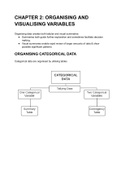
ORGANISING CATEGORICAL DATA
Categorical data are organised by utilising tables
,SUMMARY TABLE
● A summary table tallies the frequencies or percentages of items in a set of
categories so that you can see differences between categories
Devices Millennials Use to Watch Movies or Television Shows
Devices Used To Watch Movies or TV Shows Percent
Television Set 79%
Tablet 19%
Smartphone 5%
Laptop / Desktop 42%
CONTINGENCY TABLE
● Used to study patterns that may exist between the responses of two or more
categorical variables
● Cross tabulates or tallies jointly the responses of the categorical variables
● For two variables the tallies for one variable are located in the rows and the
tallies for the second variables are located in the columns
EXAMPLE:
- A random sample of 400 invoices is drawn
- Each invoice is categorised as a small, medium, or large amount
- Each invoice is also examined to identify if there are any errors
- This data is then organised in the contingency table
, TABLES USED FOR ORGANISING NUMERICAL
DATA
ORDERED ARRAY:
● An ordered array = a sequence of data, in rank order, from the smallest value
to the largest value.
● Shows range (min value to max value)
● May help identify outliers
VISUALISING VARIABLES
Organising data creates both tabular and visual summaries:
● Summaries both guide further exploration and sometimes facilitate decision
making.
● Visual summaries enable rapid review of larger amounts of data & show
possible significant patterns
ORGANISING CATEGORICAL DATA
Categorical data are organised by utilising tables
,SUMMARY TABLE
● A summary table tallies the frequencies or percentages of items in a set of
categories so that you can see differences between categories
Devices Millennials Use to Watch Movies or Television Shows
Devices Used To Watch Movies or TV Shows Percent
Television Set 79%
Tablet 19%
Smartphone 5%
Laptop / Desktop 42%
CONTINGENCY TABLE
● Used to study patterns that may exist between the responses of two or more
categorical variables
● Cross tabulates or tallies jointly the responses of the categorical variables
● For two variables the tallies for one variable are located in the rows and the
tallies for the second variables are located in the columns
EXAMPLE:
- A random sample of 400 invoices is drawn
- Each invoice is categorised as a small, medium, or large amount
- Each invoice is also examined to identify if there are any errors
- This data is then organised in the contingency table
, TABLES USED FOR ORGANISING NUMERICAL
DATA
ORDERED ARRAY:
● An ordered array = a sequence of data, in rank order, from the smallest value
to the largest value.
● Shows range (min value to max value)
● May help identify outliers


