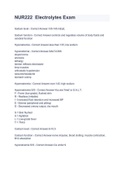
NUR222 Electrolytes Exam
NUR222 Electrolytes Exam Sodium level - Correct Answer-135-145 mEq/L Sodium function - Correct Answer-controls and regulates volume of body fluids and cerebral function Hyponatremia - Correct Answer-less than 135, low sodium hyponatremia - Correct Answer-SALTLOSS stupor/coma anorexia lethargy tendon reflexes decreased limp muscles orthostatic hypotension seizures/headache stomach cramp Hypernatremia - Correct Answer-over 145, high sodium Hypernatremia S/S - Correct Answer-You are 'fried' or S.A.L.T. F - Fever (low grade), flushed skin R - Restless (irritable) I - Increased fluid retention and increased BP E - Edema (peripheral and pitting) D - Decreased urinary output, dry mouth S = Skin flushed A = Agitation L = Low-grade fever T = Thirst Calcium level - Correct Answer-9-10.5 Calcium function - Correct Answer-nerve impulse, blood clotting, muscle contraction, B12 absorption hypocalcemia S/S - Correct Answer-Ca under 9 CATS go numb Convulsions, Arrhythmias Tetany spasms and stridor hypocalcemia level - Correct Answer-under 9 hypercalcemia level - Correct Answer-over 10.5 hypercalcemia acronym - Correct Answer-BACKME bone pain: cancer arrythmias cardiac arrest kidney stones muscle weakness excessive urination potassium level - Correct Answer-3.5-5.0 potassium function - Correct Answer-chief regulator of cellular enzyme activity and water content hypokalemia level - Correct Answer-under 3.5 hypokalemia S/S - Correct Answer-lethargy lethal cardiac dysrhythmias limp muscles low blood pressure leg cramps Low respirations diarrhea, repeated vomiting, and use of potassium-wasting diuretics hyperkalemia level - Correct Answer-over 5 hyperkalemia S/S - Correct Answer-MURDER muscle weakness urine output little respiratory failure Early: muscle twitches/cramps Rhythm change: tall T waves renal failure cardiac dysrhythmias decreases reflexes those with oliguria are at increased risk of hyperkalemia, check urine output before giving potassium meds magnesium level - Correct Answer-1.3-2.1 magnesium function - Correct Answer-metabolism of carbs and proteins, vital actions involving enzymes, neuromuscular function, enzyme actions hypomagnesemia level - Correct Answer-under 1.3 Hypomagnesia S/S - Correct Answer-diarrhea, weakness, delirium, dysrhythmias, tachycardia, cramping, increased neurovascular excitability Hypermagnesemia level - Correct Answer-over 2.1 Hypermagnesemia S/S - Correct Answer-Kidney failure decreased neuromuscular excitability Lethargy Decreased deep tendon reflexes Bradycardia Hypotension respiratory acidosis - Correct Answer-low pH, high PCO2 hypoventilation if too high PCO2 = over 45 respiratory alkalosis - Correct Answer-high pH, low PCO2, hyperventilation if too little PCO2 = less than 35 metabolic acidosis - Correct Answer-decreased pH in blood and body tissues as a result of an upset in metabolism low pH, low HCO3 decreases the level of consciousness if too little HCO3 = less than 22 metabolic alkalosis - Correct Answer-elevation of HCO3- usually caused by an excessive loss of metabolic acids high PH, high HCO3 Because HCO3− crosses the blood-brain barrier with difficulty, neurological signs and symptoms are less severe or even absent with metabolic alkalosis. if too much HCO3 = over 26 pH : acidotic - Correct Answer-below 7.35 pH : alkalotic - Correct Answer-over 7.45
Document information
- Uploaded on
- March 22, 2023
- Number of pages
- 4
- Written in
- 2022/2023
- Type
- Exam (elaborations)
- Contains
- Questions & answers