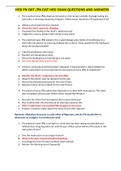
HESI PN EXIT /PN EXIT HESI EXAM QUESTIONS AND ANSWERS| Guarantee A+ Score Guide
1. The practical nurse (PN) observes hematuria in the urinary catheter drainage tubing of a client who is receiving intravenous heparin. Which action should the PN implement first? a. Obtain a urine specimen for urinalysis b. Check the client’s gums for bleeding c. Document the finding in the client’s medical record d. Irrigate the urinary catheter with sterile normal saline 2. The practical nurse (PN) explains the 2-week dosage prescription of prednisone to a client who has poison ivy covering multiple skin surfaces. What should the PN emphasize about the dosing schedule? a. Take the prednisone with meals b. Monitor oral temperature daily c. Return for blood glucose monitoring in one week d. Decrease dosage daily as prescribed 3. A client is receiving an anticonvulsant, diazepam, intravenously for status epilepticus. Which intervention is most important for the practical nurse (PN) to implement? a. Monitor the client’s respiratory rate and effort b. Observe the clients’ eyes for deviation to the side c. Record hourly blood pressures for the next 4 hours d. Measure hourly urinary output for the next 8 hours 4. The practical nurse (PN) administers filgrastim to a client with neutropenia. The client later complains of bone pain. Which action should the PN take? a. Reassure the client that neutropenia often causes bone pain b. Plan to administer the next dose at an alternate injection site c. Offer to administer a prescribed PRN analgesic to the client d. Prepare a variance report about the onset of pain after injection Rationale: Medullary bone pain is a side effect of filgrastim, and the PN should offer to administer an analgesic to provide pain relief. 5. The practical nurse (PN) is caring for a client who has been taking nonsteroidal anti- inflammatory drug ibuprofen for arthritic pain. Which action will the PN include in this client plan of care? a. Give the medication on an empty stomach b. Observe for signs of gastrointestinal bleeding c. Encourage the client to wear sunblock when outside d. Monitor the blood pressure frequently Rationale: A common side effect of NSAIDs is gastrointestinal (GI) distress. The PN should observe for any signs of GI bleeding, and these should be reported immediately, and the client should quit taking the medication. 6. The practical nurse (PN) reviews instructions for use of polyethylene glycol, a laxative, with a client scheduled for a colonoscopy. Which instruction should the PN include? a. Report the onset of watery diarrhea to the healthcare provider b. Dilute the liquid medication with fruit juice to mask the flavor c. Drink each glass of solution rapidly at regular specified time intervals d. Drink the solution with the evening meal before the scheduled exam Rationale: to produce the best effect, the client should be instructed to drink each glass (240 ml) of polyethylene glycol solution rapidly and at regular intervals
Written for
- Institution
- HESI PN EXIT
- Course
- HESI PN EXIT
Document information
- Uploaded on
- March 17, 2023
- Number of pages
- 29
- Written in
- 2022/2023
- Type
- Exam (elaborations)
- Contains
- Questions & answers
Subjects
-
hesi pn exit pn exit hesi exam questions and answers
-
1 the practical nurse pn observes hematuria in the urinary catheter drainage tubing of a client who is receiving intravenous heparin which act

Also available in package deal