
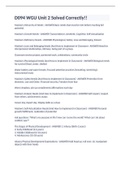
D094 WGU Unit 2 Solved Correctly!!
Maslow's Hierarchy of Needs - ANSWER Basic needs that must be met before reaching full potential. Maslow's Growth Needs - ANSWER Transcendence, Aesthetic, Cognitive, Self-Actualization Maslow's Deficiency Needs - ANSWER Physiological, Safety, Love and Belonging, Esteem Maslow's Love and Belonging Needs (And How to Implement in Classroom - ANSWER Need for interpersonal relationships, intimacy, being part of a group. Classroom service project, partnered work, celebrations, community circle Maslow's Physiological Needs (And How to Implement in Classroom) - ANSWER Biological needs for survival (food, water, shelter) Water bottles and water breaks; Focused attention practices (breathing, stretching); Instrumental music Maslow's Safety Needs (And How to Implement in Classroom) - ANSWER Protection from elements, Law and Order, Financial security, Freedom from fear Worry dropbox, pin up compliments/affirmations each day Maslow's Esteem Needs (And How to Implement in Classroom) - ANSWER Self respect, respect from others, achievement, status Career day, Expert day, Display skills as a class Maslow's Self-Actualization Needs (And How to Implement in Classroom) - ANSWER Personal growth/fulfillment, realization of potential Ask questions: "What's my purpose in life? How can I serve the world? What can I do about conflict/ war?" The Stages of Physical Development - ANSWER 1. Infancy (Birth-2 years) 2. Early Childhood (2-6 years) 3. Middle Childhood (6-10 years) 4. Adolescence (10-18 years) Infancy Physical Development Expectations - ANSWER Hold head up, roll over, sit, manipulate objects with their hands Feed themselves, jump, run awkwardly, Zip up jacket, make tower of blocks, throw a ball Early Childhood Physical Development Expectations - ANSWER Love to run, hop, tumble, string beads, put together jigsaw puzzle Print name, dress/undress themselves, eat with utensils Middle Childhood Physical Development Expectations - ANSWER Slow weight gain, coordination improves, improved writing, drawing more representational Adolescence Physical Development Expectations - ANSWER Girls go through puberty earlier, boys grow taller/more muscular, reach sexual maturity Piaget's Theory of Cognitive Development - ANSWER Children move through 4 different stages of mental development Sensorimotor, Pre-operational, Concrete Operational, Formal Operational Sensorimotor Stage - ANSWER Birth-2 years Learn about world through movement and senses; reflexive/active Object permanence* Pre-Operational Stage - ANSWER 2-7 year Pre-logical thought; Play and pretend; egocentric; concrete terms Use words to represent objects*; Pretend play* Concrete Operational Stage - ANSWER 7-11 year Logical though;Need concrete, hands-on activities; struggle with abstract and hypothetical thinking understand conservation* Formal Operational Stage - ANSWER 11+ Higher order of thinking; reason about hypothetical problems; deduce logic; strategically plan for future Abstract thinking* Schema - ANSWER Mental;/Physical actions involved in understanding and knowing Assimilation - ANSWER Taking in new information into schema Accomodation - ANSWER Changing existing schemas in light of new information Equilibrium - ANSWER Balance between assimilation and accommodation Vygotsky's Theory of Cognitive Development - ANSWER Social learning must come before cognitive development Children are born with "elementary mental functions" -Attention, Sensation, Perception, Memory Zone of Proximal Development (ZPD) - ANSWER Children may be able to achieve a skill on their own, but when guidance is offered from a more knowledgeable person, they may acquire the skill more quickly. Difference between what the child attains independently and with support of someone more skilled. Types of Language - ANSWER Social, Private, Silent Inner Speech Social Speech - ANSWER Talking to other people Private Speech - ANSWER Talking to self, out loud Silent Inner Speech - ANSWER Self-regulation speech, thoughts Erikson's Stages of Psychosocial Development - ANSWER People are motivated by the need to achieve competence in certain areas of their life 1. Trust V. Mistrust 2. Autonomy V. Shame 3. Initiative V. Guilt 4. Industry V. Inferiority 5. Identity V. Role Confusion 6. Intimacy V. Isolation Trust V. Mistrust - ANSWER 0-12 Mo -Learn that adults can be trusted -Learned by getting basic needs for survival met by adults -If not attained, causes Fear, Anxiety, and Mistrust Autonomy V. Shame - ANSWER 1-3 year -Learn that they control their actions, and act on their environment -Learned by playing with toys, eating food with hands, and putting on their own clothes -If not attained, causes doubt in their abilities, low self-esteem, and shame Initiative V. Guilt - ANSWER 3-6 year -Learn to initiate activities and assert control -Learn by planning and achieving goals with others -If not attained, causes feelings of guilt Identity V. Role Confusion - ANSWER 12-18 year -Begin comparing to others -Show pride in school, sports, family, life -If not attained, creates inferiority complex Industry V. Inferiority - ANSWER 6-12 year -Learn to develop sense of self -Learn by setting goals, discovering "adult self" -If not attained, causes confusion about future, becomes unsure of identity, causes confusion about future, becomes unsure of identity Intimacy V. Isolation - ANSWER 20s-40s -Ready to share life with other -Develop strong sense of self -If not attained, causes loneliness, emotional isolation Bandura's Theory of Observational Learning and Modeling - ANSWER Learn by watching others and then imitating/modeling 3 types: live, verbal, symbolic Bandura Model Types - ANSWER 1. Live: Demonstrates in person 2. Verbal: Doesn't perform behavior, but explains/describes behavior 3. Symbolic: Fictional/real people in books/tv that demonstrate behavior Social Learning Theory - ANSWER The theory that we learn social behavior by observing and imitating and by being rewarded or punished Kohlberg's Stages of Moral Development - ANSWER Moral dilemmas to teach morality and values 3 levels of moral reasoning: Pre-conventional, Conventional, Post Conventional Pre-conventional Morality - ANSWER Sense of morality is controlled externally, focuses on external consequences that certain actions may bring. Stage 1: Obedience and punishment orientation Stage 2: Instrumental orientation Conventional - ANSWER Sense of morality is tied to personal and societal relationships; rules seldom questioned Stage 3: Good boy, nice girl orientation Stage 4: Law and order orientation Post-Conventional - ANSWER Morality is defined in abstract principles/values; individual is separate from society Stage 5: societal contract orientation Stage 6: Universal ethical principle orientation Kohlberg's Classroom Application - ANSWER Stage 1: develop clear system of rules and expectations Stage 2: Explanations behind rules Stage 3: Explain how misbehavior affects others Stage 4: Discussion to develop rules Stage 5: Flexible rules (reinterpreted/revised) Levels for social and emotional development - ANSWER Grade school: conversation, test boundaries, develop identity Middle/High School: Think logically, value friends opinions, strive for independence Chomsky's Theory of Language Development - ANSWER believes all languages share some basic elements, or universal grammar (all have nouns, verbs, adjectives as building blocks) Children have innate ability to learn languages Skinner's Theory of Language Development - ANSWER Children learn languages based on behaviorist reinforcement principles by associating words with meanings (positive reactions to pronouncing a word correctly helps them learn faster) 1. Motivating operations 2. Discriminative Stimuli 3. Response 4. Reinforcing Stimuli Vygotsky's Sociocultural Approach - ANSWER the approach that emphasizes how cognitive development proceeds as a result of social interactions between members of a culture, believes that people and settings influence a child, who in turn influence the people and settings Language Development Stages - ANSWER 1. Babbling 2. Holophrastic 3. Two-word 4. Telegraphic Babbling Stage - ANSWER 0-11 month Recognize and produce sounds Unable to form sentences, define/understand words Holophrastic - ANSWER 11 months-1.5 years One-word Over generalized (all 4-legged animals are dogs) Two-Word - ANSWER Up to 2.5 years Noun-Noun/Noun-Verb (Doggie bark) Better understanding of syntax Develop own meaning using context ques Telegraphic - ANSWER 2.5 years - Progress quickly once essentials are grasped Extrinsic - ANSWER Resulting from student's environment or circumstances Ex. Homlessness Atypical - ANSWER Unusual Behaviors associated with developmental barriers - ANSWER Diff. with adaptive behaviors Short attention span and poor listening skills Diff. remembering instructions Diff. completing tasks on time Problems with abstract concepts Common Characteristics of a student with TBI (Traumatic Brain Injury) - ANSWER Slower Mental, verbal, and physical response Diff. expressing themselves in speech and writing Diff. understanding course material Depression/mood changes Mental fatigue, vision problems, headache, etc. Adaptive Behavior - ANSWER Having daily living, social, and communication behavior to function independently Autism - ANSWER Neurodevelopmental disorder characterized by inhibited social interaction and communication and by restricted, repetitive behavior Social and Emotional Development Barriers - ANSWER Appearing withdrawn, shy, anxious Weakened self-esteem
Document information
- Uploaded on
- March 13, 2023
- Number of pages
- 10
- Written in
- 2022/2023
- Type
- Exam (elaborations)
- Contains
- Questions & answers


