
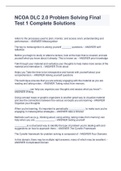
NCOA DLC 2.0 Problem Solving Final Test 1 Complete Solutions
The foundation of relationships with others and faith in a system is called____________. - ANSWER Trust When you trust the person or group with whom you are engaged in negotiations, you believe the __________ they present is truthful and accurate. - ANSWER Information ____________ Power is made up of referent, information, and Expert. - ANSWER Personal Coercive, reward, connection, and legitimate power are _________ powers. - ANSWER Position Defining the problem and identifying possible resources are all _______________ to potentially solve a problem. - ANSWER Options Knowing the _________, the _______, and the _________ is critical in determining how to negotiate. - ANSWER Who, stakes, and situation Depending on the stakes and situation, the approach places more importance on the outcome, solution, or resolution - ANSWER Task orientation The _________ strategy depends heavily on each party's collaborative efforts and desire to achieve a mutually satisfactory outcome. - ANSWER Cooperative Negotiation Stradegy A _________ is an alternative that, should negotiations fail, you are willing and able to execute without the opposite's negotiator participation or permission. - ANSWER BATNA The capacity of parties to decide in its best interest to negotiate an agreement rather than to continue a dispute. - ANSWER Readiness ________ means that it is good timing to negotiate. - ANSWER Ripeness __________ negotiations are usually over a single-issue and considered win-lose. - ANSWER Distributive The type of negotiation that does not see resources as necessarily fixed and should be approached as a win-win situation is ________. - ANSWER Integrative This approach centers on the relationship that exists between the individuals or groups involved. - ANSWER People orientation This type of vital decision making tool that operates in the background of your mind. - ANSWER System 1 thinking NCOs better resolve problems by visualizing information given, details, and situations from different points of view using: - ANSWER Analytical thinking This type of thinking is reflective thinking, is broad and informed problem-solving and deliberate decision making. - ANSWER System 2 thinking This type of thinking is employed in complex, challenging, and often stressful situations and requires deliberate practice and repetition. - ANSWER Adaptive Thinking Keeping an open mind, employing active listening and encouraging fresh perspectives to generate new and improved systems, process., and solutions as part of: - ANSWER Creative Thinking The creation of the wheel, telephone, automobile, and internet are all types of: - ANSWER Innovative Thinking A goal of deliberate practice is to develop habits that operate expertly and automatically through: - ANSWER Repetition Providing feedback and constructive criticism to a learner at regular intervals is characterized as this type of deliberate practice. - ANSWER Focused Feedback New and better ideas that may dismantle the existing structure of the organization is: - ANSWER Revolutionary Innovation Innovations focused on identifying areas that represent something "distinctly new and improved" are: - ANSWER Evolutionary Innovations Cutting costs, reducing cycle time, and improving quality are examples of: - ANSWER Efficiency Innovations What's the type of thinking involved in solving problems, formulating inferences, calculating likelihoods, and making decisions. - ANSWER Critical thinking Reactive thinking is known as? - ANSWER System 1 thinking What are the 5 W's used in analytical thought are? - ANSWER Who, what, when, where, and why? What is a diagram that begins with central topics usually placed in the middle, with sub topics and relevant details branching from the topic? - ANSWER Mind-mapping The domain of good practice - ANSWER Simple Domain In the simple domain, leaders must: - ANSWER Sense, categorize, and respond. The domain of of good practice is: - ANSWER Complicated Domain The domain of emergent practices is: - ANSWER Complex domain What is the the best outcome each negotiator hopes to achieve from a negotiated agreement? - ANSWER Aspiration point
Document information
- Uploaded on
- March 9, 2023
- Number of pages
- 5
- Written in
- 2022/2023
- Type
- Exam (elaborations)
- Contains
- Questions & answers


