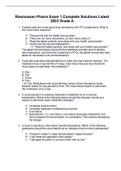
Rasmussen Pharm Exam 1 Complete Solutions Latest 2023 Grade A
1. A patient asks the nurse about drug interactions with OTC preparations. What is the nurse's best response? A. "Discuss this with the health care provider." B. "There are not many interactions, so don't worry about it." C. "Read the labels carefully, and check with your health care provider." D. "Avoid over-the-counter preparations." - C. "Read the labels carefully, and check with your health care provider." The patient should always check with the healthcare provider prior to starting new medications, and since this is referring to OTCs, the patient should also read labels for interactions and contraindications. 2. A provider prescribes phenobarbital for a client who has a seizure disorder. The medication has a long half life of 4 days. How many times per day should the nurse expect to administer this medication? A. One B. Two C. Three D. Four - •A. One. Medications with long half lives remain at their therapeutic levels between doses for long periods of time. The nurse should expect to administer this medication once a day. 3. A nurse educator is reviewing medication metabolism at an in service presentation. Which of the following factors should the educator include as a reason to administer lower medication dosages? A. Increased renal excretion B. Increased medication metabolizing enzymes C. Liver failure D. Hypertension - C. Liver failure. Liver failure decreases metabolism and thus increases the concentration of a medication. This requires decreasing the dosage. 4. A nurse is teaching a client about transdermal patches. Which of the following statements should the nurse identify as an indication that the client understands? • A. "It doesn't' matter if I clean the site before I apply the patch." B. "I will rotate the application sites weekly." C. "I will apply the patch to an area of skin with no hair." D. "I will place the new patch on the site of the old patch." - C. "I will apply the patch to an area of skin with no hair. "The client should apply the patch to a hairless area of skin to promote absorption of the medication. 5. A nurse is preparing a client's medications. Which of the following actions should the nurse take in following legal practice guidelines? (Select all that apply.) • A. Teach the client about the medication. B. Determine the dosage. C. Monitor for adverse effects. D. Lock compartments for controlled substances. E. Determine the client's insurance status. - A. Teach the medication as part of the rights of medication administration. • C. Monitor for adverse effects as part of the rights of medication administration. • D. Lock controlled substances in a drawer, cart, or other compartment to prevent misuse. 6. A nurse is preparing to administer digoxin to a client who states, "I don't want to take that medication. I do not want one more pill." Which of the following responses should the nurse make? • A. "Your physician prescribed it for you, so you really should take it." B. "Well, let's just get it over quickly then." C. "Okay, I'll just give you your other medications." D. "Tell me your concerns about taking this medication." - "Tell me your concerns about taking this medication." D. Although clients have the right to refuse a medication, this response is correct in determining the reason for refusal by asking about the client's concerns. Then information can be provided about the risk of refusal and facilitate an informed decision. At that point, if the client still exercises their right to refuse a medication, notify the provider and document the refusal and the actions taken. 7. A nurse is reviewing a client's prescribed medications. Which of the following situations represents a contraindication to medication administration? • A. The client drank grapefruit juice, which could reduce a medication's effectiveness. B. The medication has orthostatic hypotension as an adverse effect. C. A medication is approved for ages 12 and older, and the client is 8 years old. D. An antianxiety medication that has an adverse effect of drowsiness is prescribed as a preoperative sedative. - C. Age is one factor that can be a contraindication to medication administration. Contraindications are findings that indicate the client should not receive a medication and are different from instances where an undesirable effect or more monitoring are needed. 8. A nurse is assessing a client before administering medications. Which of the following data should the nurse obtain? (Select all that apply.) • A. Use of herbal products B. Daily fluid intake C. Ability to swallow D. Allergies - A. CORRECT: Inquire about the client's use of herbal products, which often contain caffeine, prior to medication administration because caffeine can affect medication biotransformation. • C. CORRECT: Determine the client's ability to swallow to see what route or formulation of the medication the client requires. • D. CORRECT: Inquire about food allergies during the preassessment to identify any potential reactions or interactions. 9. A nurse is working with a newly licensed nurse who is administering medications to clients. Which of the following actions should the nurse identify as an indication that the newly hired nurse understands medication error prevention? • A. Taking all medications out of the unit dose wrappers before entering the client's room B. Checking the prescription when a single dose requires administration of multiple tablets C. Administering a medication, then looking up the usual dosage range D. Relying on another nurse to clarify a medication prescription - B. Checking the prescription when a single dose requires administration of multiple tablets. If a single dose requires multiple tablets, it is possible that an error has occurred in the prescription or transcription of the medication. This action could prevent a medication error. 10. A nurse is caring for a client experiencing IV extravasation. The facility requires the administration of an antidote for the prescribed IV solution. After stopping the IV infusion, which of the following actions should the nurse take first? • A. Remove the IV catheter. B. Withdraw the solution from the IV access. C. Administer the antidote to the vesicant. D. Insert a new IV access in a different extremity. - B. Withdraw the solution from the IV access. According to evidence-based practice, the nurse should first withdraw the solution from the IV access. This reduces the amount of vesicant in the body, and lowers the risk of tissue damage.
Document information
- Uploaded on
- March 8, 2023
- Number of pages
- 11
- Written in
- 2022/2023
- Type
- Exam (elaborations)
- Contains
- Questions & answers